

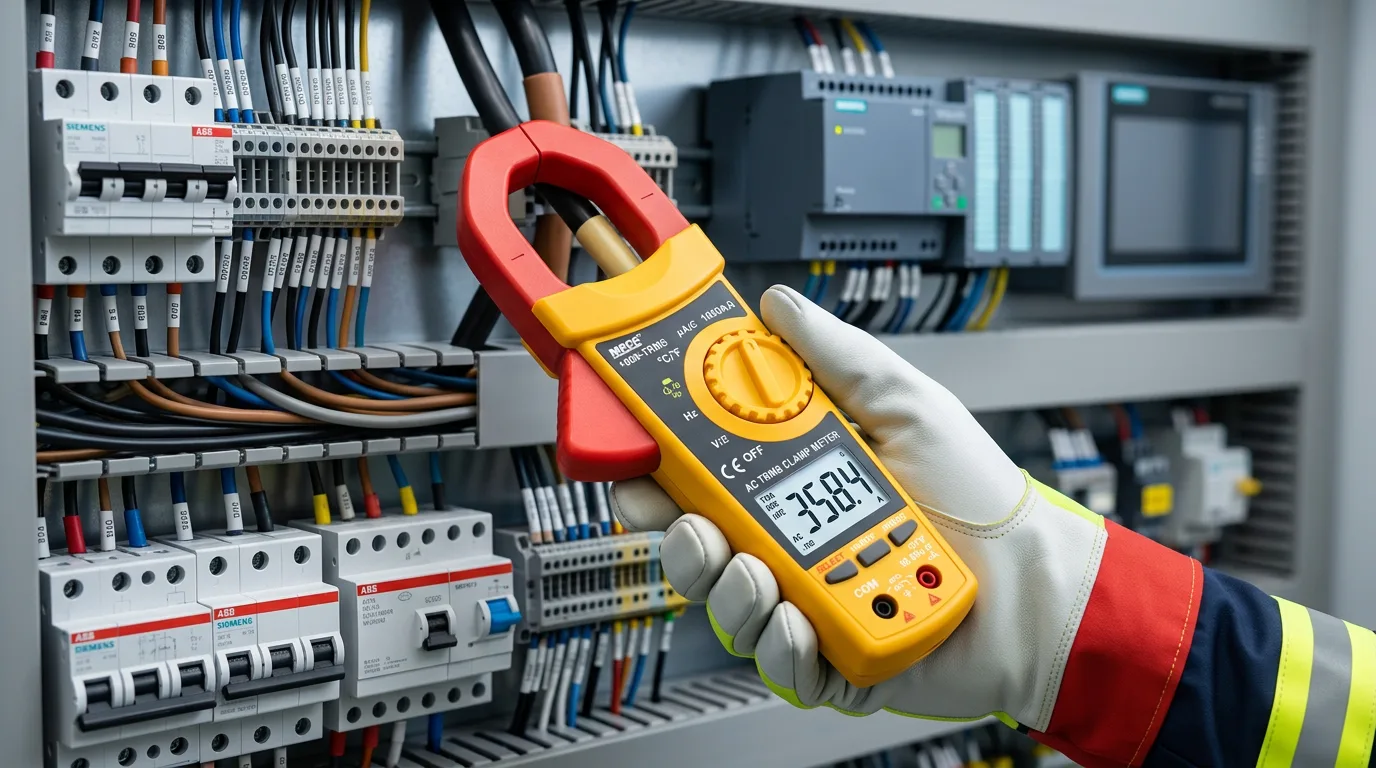
Ask any electrician what's in their bag and a clamp meter is almost always there. Not buried at the bottom either - usually right on top, because it gets used that often. The reason is simple: it lets you check current without cutting into a live wire first. New to electrical testing? This guide keeps things plain - no jargon dump. We'll walk through Original Clamp Meters, why the Meco Clamp Meter range gets picked so often, and what actually matters when you're choosing one for real work, not just for a spec sheet.
What is a Clamp Meter?
Picture a pair of jaws that open up, wrap around a single conductor, then close again - no stripping wires, no touching bare copper. That's the basic idea. Inside those jaws sits a sensor (current transformer in most models, sometimes a Hall effect sensor for DC) that reads the magnetic field around the wire and turns it into a number on the screen. A lot of these units do more than current, too - voltage, resistance, continuity, sometimes frequency. In that sense they behave a bit like Meco Digital Multimeters, just with a clamp bolted on for safer, faster readings. Safety plus speed - that combination is basically why this tool ended up everywhere.
Why is it Important?
Electricity doesn't forgive mistakes. So accuracy matters, sure - but staying alive while you measure matters more. A solid clamp meter earns its place because it:
- Checks current without you ever disconnecting a wire
- Keeps you further away from live terminals - less arc flash exposure
- Cuts troubleshooting time on motors, panels, whatever's acting up
- Gives readings you can actually log for maintenance records
- Handles AC, DC, or both - depends which model you've got
If you're running maintenance across a site, having a Best Clamp Meter within reach just... saves you time. Less downtime, fewer headaches, safer shifts for the team.
Types and Variants
Not all clamp meters do the same job. Here's roughly how they break down:
- AC Clamp Meters - alternating current only, fine for homes and lighter industrial work
- AC/DC Clamp Meters - covers both, useful for automotive work, solar setups, industrial panels
- Leakage Clamp Meters - built to catch tiny current leaks during safety checks
- True RMS Clamp Meters - stay accurate even when a variable speed drive distorts the waveform
- Mini Clamp Meters - small enough to fit where panel space is tight
Most people hunting for an Original Clamp Meter end up at the Meco Clamp Meter lineup - one brand, most of these categories covered, and sourced through channels you can actually trust.
Trivia: Old-school clamp meters used analog needles - digital displays came along much later.
Features to Look For
Before you buy, run through this list:
- Jaw size that actually fits your cable diameter
- True RMS - non-negotiable if loads aren't clean sine waves
- CAT III or CAT IV rating, matched to your panel voltage
- Backlit display - you'll thank yourself in a dim panel room
- Auto-ranging, so you're not fumbling with dial settings
- Data hold plus min/max - handy for one-person jobs
- Low battery and overload warnings built in
A genuine Mecoinst Clamp Meter in India usually ships with all of this as standard - not extras you pay more for. That consistency is exactly what keeps technicians coming back to it.
Product Overview
Good clamp meters share a few traits: tough outer casing, sensors that hold calibration over years, not months. Sourcing through established Mecoinst Clamp Meters Dealers in India tends to matter here - authorized channels back up that calibration claim with actual support when something goes wrong. These instruments don't work in isolation either; pair one with a digital multimeter, an earth tester, maybe a phase sequence meter, and you've got a proper test kit for panel building or maintenance rounds. Worth it, too - warranty claims and spare parts get a lot less painful when you bought through a verified partner in the first place.
Benefits
Here are the benefits of Clamp Meter:
- No-contact safety while measuring live current
- Faster than digging out an old-style ammeter
- Works across industrial, commercial, even home setups
- Holds up for years - if you keep it calibrated
- Small, light, easy to carry between job sites
That's largely why people typing Clamp Meter Near me into a search bar don't just grab the first result - they end up comparing specs, brand reliability, calibration support. Convenience matters, but not at the cost of accuracy.
Fact: True RMS models stay accurate even when the waveform isn't a clean sine wave
Applications and Use Cases
Here are the applications of Clamp Meter:
- Watching motor and pump current in a factory setting
- Tracking down faults on panel boards
- HVAC diagnostics - routine and emergency calls alike
- Checking current on solar inverters and battery banks
- Preventive maintenance rounds, the kind that catch problems early
- Training labs - students need to learn on real gear
Mecoinst Clamp Meters Suppliers in India cover pretty much all of these sectors - OEMs, contractors, system integrators - delivering instruments that actually meet recognised calibration standards, not just claim to.
Did You Know: You can measure current through insulated cable without ever touching bare copper
Comparison Table: Clamp Meter Types at a Glance
Understand clamp meter better with the comparison of its various types:
| Type | Best For | Key Strength |
|---|---|---|
| AC Clamp Meter | General residential and light industrial use | Simple operation, affordable |
| AC/DC Clamp Meter | Industrial panels, automotive, solar setups | Versatile current handling |
| Leakage Clamp Meter | Safety audits and inspections | Detects micro current leakages |
| True RMS Clamp Meter | Variable frequency drives, distorted loads | Accurate non-sinusoidal readings |
| Mini Clamp Meter | Tight panel spaces, compact wiring | Easy handling in confined areas |
Expert Tips and Buying Guide
Here are the expert tips to help guide you for buying a clamp meter:
- Check jaw size against your biggest cable before anything else
- Match CAT rating to the voltage environment you'll actually work in
- Go True RMS if VFD-driven equipment is part of your routine
- Stick with verified Mecoinst Clamp Meter Wholesalers in India - counterfeits aren't worth the risk
- Weigh Clamp Meter Price against accuracy class, not just the number on the tag
- Get a calibration certificate every single time you buy
S.S. Electronics
Established in 2004 and headquartered in Noida, Uttar Pradesh, India, S.S. Electronics is a reliable supplier and dealer of industrial automation and electrical products. With the guidance of Mr. K.D. Joshi and 20+ years of experience in this field, the company deals in power supplies, controllers, relays, connectors, energy meters, testing instruments, and many other automation products from top manufacturers across the globe. As an ISO 9001:2015 certified company, S.S. Electronics ensures top quality products, a competitive price range, good technical support and timely deliveries for their clients. Catering to panel builders, OEM's, system integrators, contractors all over India, S.S. Electronics thrive on integrity, reliability and customer satisfaction.
FAQs
1: What is a clamp meter used for?
Ans: A clamp meter is mainly used to measure electrical current without breaking the circuit. You just clamp the jaws around a wire and get a reading instantly. Technicians use it for motor checks, panel troubleshooting, and routine maintenance — it's faster and safer than older contact-based methods.
2: How is a clamp meter different from a regular multimeter?
Ans: A regular multimeter needs direct contact with the circuit, which means more risk around live wires. A clamp meter skips that — it reads current through the jaws alone. Many models also handle voltage and resistance, so they work a lot like a multimeter with extra safety built in.
3: Can a clamp meter measure both AC and DC current?
Ans: It depends on the model. Basic clamp meters only handle AC current, fine for most household or light industrial work. AC/DC versions cover both, which matters for solar setups, automotive work, or industrial panels. Always check the spec sheet before buying if DC readings are part of your job.
4: Why should I choose a True RMS clamp meter?
Ans: True RMS models give accurate readings even when the current waveform isn't a clean sine wave — common with variable frequency drives or non-linear loads. Standard clamp meters can misread these signals badly. If your work involves industrial motors or VFDs, True RMS isn't optional, it's necessary for trustworthy data.
5: How do I pick the right clamp meter for my work?
Ans: Start with jaw size — it needs to fit your largest cable comfortably. Then check the CAT safety rating against your voltage environment, confirm True RMS if needed, and look for auto-ranging plus a backlit display. Buying from a verified dealer also protects you from counterfeit or miscalibrated units.
6: Are original clamp meters worth the extra cost over cheaper alternatives?
Ans: Yes, generally. Original clamp meters come calibrated to industry standards and hold accuracy longer, which matters for safety and maintenance logs. Cheaper, unverified units often drift out of calibration fast. The slightly higher upfront cost usually pays off through fewer replacements and more reliable readings over time.
Conclusion
At the end of the day, a clamp meter is one of those tools you don't think twice about until it's missing from your kit. Factory floor or home wiring job - doesn't matter - genuine instruments backed by real supply chains just perform better, longer. When comparing options, look past the price tag first. Authenticity, safety rating, calibration support - get those right and the savings show up later, not upfront.
Get in Touch
| Need a dependable, original clamp meter for your team? Contact to SS Electronics for genuine instruments and honest buying advice. |