

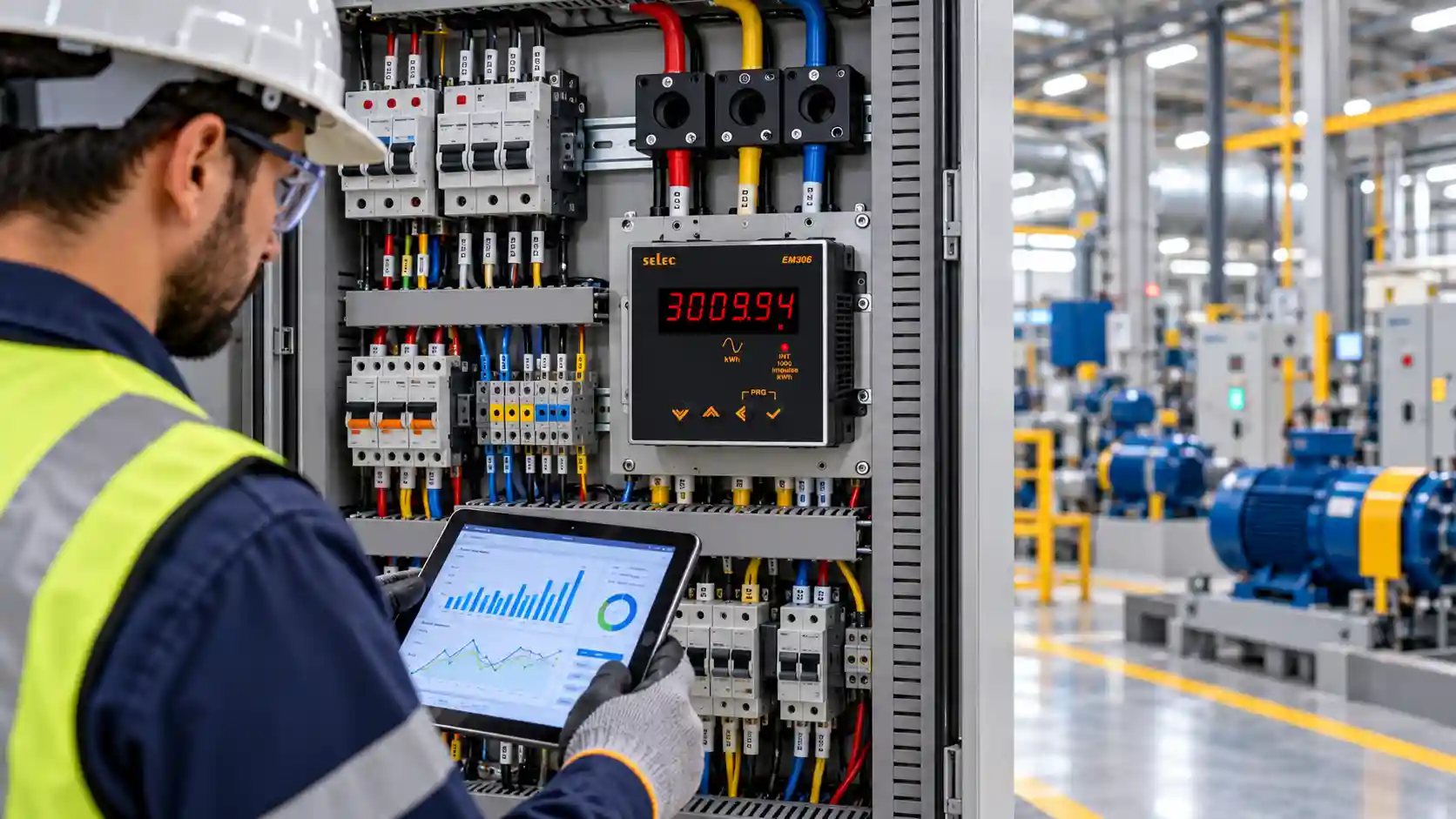
Most facilities don't actually know how their power gets used, not down to the machine or the shift. HVAC runs, motors kick in, lights stay on longer than tracked, and the bill just shows up as one number. An Energy Meter breaks that number apart, reading consumption as it happens and flagging where the load is heaviest.
We work with manufacturers who'd rather install the right Industrial Energy Meter upfront than deal with unexplained spikes six months down the line.
What Is an Energy Meter?
An Energy Meter, put simply, is a measuring device. It logs how much electrical energy moves through a circuit, a machine, or a building, and older units did this with a small spinning disc read manually off a dial. A Digital Energy Meter swaps that mechanical spin for electronic sensing, which reads faster and holds tighter accuracy.
For industrial buyers, an Electrical Energy Meter isn't paperwork for its own sake. It's what actually explains the electricity bill.
|
Trivia: “The earliest commercial electricity meters date to the 1880s and relied on a mercury-motor mechanism to register usage, a far cry from the circuitry inside a modern Digital Energy Meter, though the underlying principle hasn't really changed.” |
How Does an Energy Meter Work?
Nothing complicated about the mechanics. The meter reads voltage and current continuously, calculates instantaneous power, and adds that up over time to arrive at energy consumed, the kWh figure on an invoice. A Power Energy Meter performs this calculation constantly, converting electrical signals into usable numbers almost instantly.
Some units store readings for later review. Others display everything live. The Energy Meter Working Principle, whichever model you pick, stays consistent: measure, compute, report.
Why Accurate Power Monitoring Matters in Industries
Facilities that don't track consumption closely tend to find out about problems the expensive way, through the bill rather than a warning sign. Accurate Power Monitoring gives teams a way to see consumption trends early, spot equipment pulling more current than it should, and prepare for peak-load periods.
An Industrial Energy Meter isn't there purely for compliance paperwork. Used properly, it functions almost like an early-warning system, and consistent Energy Monitoring is what makes that possible.
How Energy Meters Support Better Energy Efficiency
Once consumption data is visible, behaviour tends to follow. Facilities using an Energy Meter regularly start noticing patterns that were previously buried inside a monthly total. An Energy Monitoring Meter won't change anything by itself, of course, but it does show exactly where Energy Efficiency improvements are worth chasing.
Track Real-Time Energy Consumption
This is where the timing advantage really shows up.
- A Digital Energy Meter records consumption minute by minute rather than waiting for a monthly cycle.
- Sudden increases surface immediately, so nobody's finding out three weeks later from a paper bill.
- That immediacy is essentially what Energy Consumption Monitoring is built to deliver.
Identify High Energy Consumption Areas
Different equipment draws differently, and it's rarely obvious just by looking.
- Meter readings usually point to the specific line, machine, or section responsible.
- A spike that wasn't there last month often traces back to a worn bearing, a failing motor winding, or a loose terminal connection.
- Instead of inspecting the entire floor, Energy Monitoring narrows it down to whatever the data actually flags.
Support Energy Cost Management
Money leaks quietly when nobody's watching consumption by shift or process.
- Trend data shows which production run, shift timing, or season is genuinely driving the cost up.
- An Energy Meter converts a single monthly total into something a finance or operations team can actually break down.
- The result is fewer surprises at month-end, which is really what Energy Cost Management comes down to.
Improve Equipment and Process Monitoring
A power reading can sometimes flag a problem before a technician would.
- An unexplained rise in draw often signals mechanical strain building up somewhere in the line.
- Regular Power Monitoring supports preventive checks rather than reactive repairs after something's already failed.
- Combined with a maintenance schedule, an Industrial Energy Meter effectively doubles as an early diagnostic tool.
|
Did You Know? “Most manufacturing floors run on three-phase power rather than single-phase, mainly because three-phase handles heavy industrial loads with a lot less strain on the system.” |
Common Industrial Applications of Energy Meters
These meters end up almost anywhere electricity gets consumed at scale, which, on an industrial floor, is nearly every section.
- Manufacturing plants and production lines
- Electrical control panels and distribution boards
- Commercial buildings and office complexes
- HVAC systems and centralized cooling
- Heavy machinery and process equipment
- Utility metering and integrated energy-management platforms
Wherever consumption needs tracking at that scale, Energy Meter Applications tend to follow, and SS Electronics has supplied across most of these environments.
Key Factors to Consider When Choosing an Energy Meter
Buying the wrong meter usually comes down to skipping a spec check. A short list of specs, checked early, saves a lot of trouble once the order's already placed.
Single-Phase or Three-Phase System
This decision affects everything installed after it.
- Lighter loads and standard single circuits are typically covered by a Single Phase Energy Meter.
- Heavier industrial demand, the kind most production floors carry, usually calls for a Three Phase Energy Meter.
- The meter should match the existing supply, never the other way round.
Single Phase vs Three Phase Energy Meter: Quick Comparison:
| Aspect | Single Phase Energy Meter | Three Phase Energy Meter |
|---|---|---|
| Typical Use | Small loads, single circuits, light commercial setups | Heavy industrial loads, larger facilities, production lines |
| Power Supply | Runs on a single live wire and neutral | Runs across three live wires for higher capacity |
| Load Handling | Suited to lighter, steady electrical demand | Built for fluctuating, high-capacity industrial demand |
| Common Setting | Offices, small workshops, retail spaces | Manufacturing plants, heavy machinery, control panels |
Measurement Parameters and Accuracy
Accuracy class is where a lot of buyers cut corners without realizing it.
- Confirm whether voltage, current, power factor, or all three need tracking for the application.
- Digital Energy Meter models differ noticeably in Energy Meter Accuracy ratings depending on build quality.
- Process-critical monitoring or billing purposes generally justify paying for the higher accuracy class.
Display and Communication Features
Some facilities just need a readable screen. Others need the data talking to a larger system.
- A clear on-device display is enough for periodic manual checks.
- Communication-enabled models push readings directly into automation or monitoring software.
- Facilities scaling up their monitoring setup usually benefit from a Digital Energy Meter with built-in connectivity, feeding into a broader Energy Monitoring Meter network.
|
Fact: “Facilities that maintain consistent Power Monitoring tend to catch abnormal consumption patterns earlier, often well before a developing mechanical fault turns into an unplanned shutdown.” |
What to Check When Choosing an Energy Meter Supplier
Reliability varies more between suppliers than most buyers expect. A few checks are worth doing before placing an order.
- Genuine, certified components, not substitutes passed off as equivalents.
- A wide enough range of models and specifications to actually have options.
- Technical guidance that matches the meter to the application, not a generic recommendation.
- Pricing that stays transparent instead of adding costs later.
- Capacity to support bulk industrial orders with realistic delivery timelines.
- After-sales support that's actually reachable when something needs replacing.
An Energy Meter Supplier that covers all of this isn't common, but it's what SS Electronics has built its reputation on as an Energy Meter Dealer. For anyone sourcing an Energy Meter in India, that track record tends to matter more over time than a marginally lower quote.
Conclusion
An energy meter is rarely just a billing instrument bolted to a wall. Done right, it's the foundation for genuine Power Monitoring, better Energy Efficiency decisions, and tighter cost control across daily operations. Selecting the right Energy Meter comes down to matching it to your electrical system, your monitoring goals, and a supplier who stands behind the product. SS Electronics offers that combination to facilities across India.
Frequently Asked Questions
1. What is an energy meter used for?
An Energy Meter keeps a running count of electrical energy used by a circuit, a machine, or a facility. Billing runs off that number, but so does day-to-day monitoring, catching a usage pattern that's drifted from normal. Industrial teams rely on it to control costs and know where electricity is going.
2. How can an energy meter help improve energy efficiency?
Once consumption is visible hour by hour instead of buried in a monthly total, wasteful patterns tend to stand out, a machine idling too long, a process running hotter than it should. An Energy Meter surfaces that. What a team does with the reading drives the real Energy Efficiency gains.
3. How do I choose the right energy meter?
Start with the electrical phase, then work out what needs measuring and at what accuracy. Some setups need nothing more than a clear display; others need the meter talking to a monitoring system. Get those basics right, work with a solid Energy Meter Supplier, and the decision gets easier.
4. What is the difference between single-phase and three-phase energy meters?
Single-phase suits the smaller stuff, standard circuits, lighter loads. Three-phase is built for bigger industrial demand, the kind a production floor generates all day. Which one you need, a Single Phase Energy Meter or a Three Phase Energy Meter, comes down to the facility's existing power supply.
5. Can energy meters be integrated with monitoring software?
Plenty of them, yes. Several Digital Energy Meter models send consumption data straight to a monitoring or automation platform as it's recorded. That's what centralized Energy Monitoring looks like in practice, one dashboard covering multiple meters and lines, instead of someone walking the floor with a clipboard.
6. Why should I choose to purchase an energy meter from a reputable energy meter supplier?
The other option would prove costly in the long run. It is a guarantee that the parts used would be genuine and the advice given will not only suit your requirements but also be relevant to your needs and not a generic sales pitch.