
Let's face it, no one wants to grow up to be a contactors. If, however, the part you're responsible for keeping from burning up or the motor from stalling during the drive, it's the star of your day. Well, let's get down to the tea, shall we? Is a generic power contactor good enough, or should you upgrade to a product from an OG brand? It's coming to you in an un-jargonized manner, and it's the information that will make a difference in your decision.
It's a question that panel builders, OEMs and procurement teams ask themselves quite a bit more often than I can imagine and for a given project, it's not necessarily the same. There are many factors that affect the math, such as load type, switching frequency and downtime. Let's check out features, ratings and where each type really lives up to the standard.
What's a Power Contactor, Really?
The Power Contactor can be thought of as the bouncer of your electrical circuit. It is placed between a low voltage control signal and a high current load and it only allows serious power to flow to the motors, lighting banks, heating units or industrial machinery when it gets the "green light" – safely and hundreds of thousands of times, without fail. There's no manual switch for such a punishment.
The key to a good contactor is contact stability, thermal endurance, and its ability to withstand India's unique circumstances of voltage fluctuations and heavy duty. For a generic unit, it's technically possible to switch power, but it's noticeable when the load is significant.
Trivia:
The word "contactor" literally comes from "contact" — early 1900s engineers named it for the simple act of making and breaking electrical contact, and the core mechanism hasn't changed much in over a century.
Enter the Schneider Electric Contactor
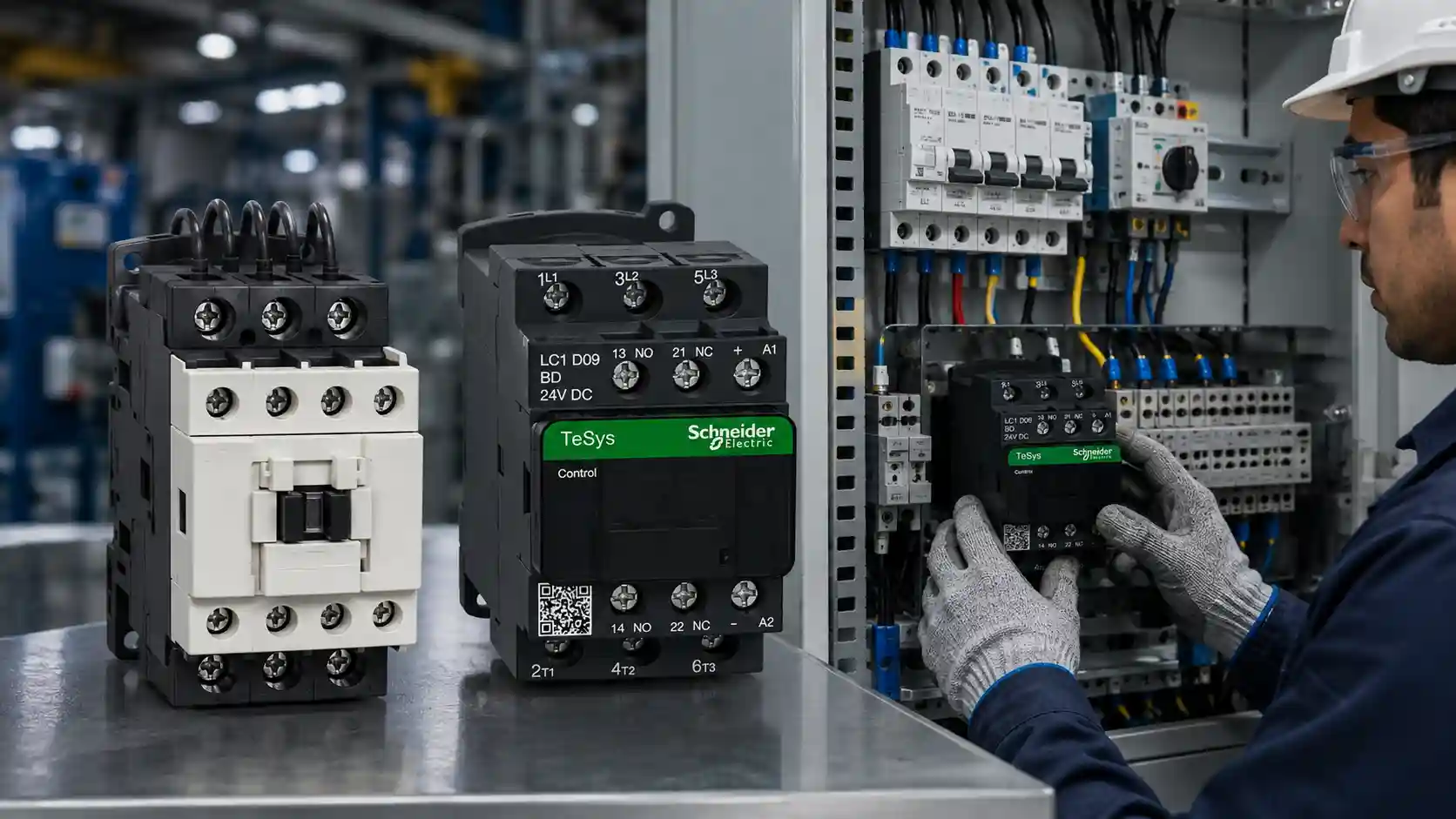
Now take a closer look at the Schneider Electric Contactor — with a global standard behind it that's engineered for the same core job. They are constructed by Schneider using better contactor material, optimized coil design and insulation configurations that are designed to withstand repeated electrical stresses and temperature changes.
It is not a magic difference in what is done by a Schneider unit. It's just that the margins are narrower: the arc suppression is purer, switching is more reliable, and failure rates become significantly less particularly in mission critical applications. Basically "it works" and "it works reliably for years.”
Feature Showdown: Build, Coils & Cycles
The specifications on paper are the same, but three things happen in the background that determine how long a contactor will last on the job:
- Contactor material— Schneider prefers to go for higher grade alloys with stricter mechanical tolerances (less pitting and overheating), and gives general-grade alloys for lighter switching.
- Coil voltage and control compatibility — When coils and controls are incompatible, chatter and wear will result from mismatched coil voltage. For more automation focused setups, Schneider contactors are integrated with PLCs, timers and relays.
- Arc suppression – Standard units are fine for moderate cycling; Schneider's arc chamber design is optimized for high frequency start-stop applications.
Trivia:
A single contactor can be rated for over a million mechanical operating cycles before wear-out — that's roughly one switch every few seconds, non-stop, for weeks.
Rating that Truly Moves the Needle
The most frequently checked rating is the current one, and for good reason: If you run the motor at less than the current rating, you run the risk of motor damage, burning out contacts and overheating. However, don't underestimate switching frequency and duty cycle. When making a decision to place an order, consider:
- Design and installation of ventilation around the panels and ambient temperature
- The number of shift cycles that the load actually experiences, not the theoretical number.
- Insulation class and short circuit withstand rating for your panel design.
- Whether slight oversizing on switching frequency makes sense — it usually costs less than an unplanned mid-project replacement
Quick Comparison: Power Contactor vs. Schneider Electric Contactor
The table gives you the quick take — here's the full picture on why each of these differences shows up on the shop floor.
| Parameter | Power Contactor | Schneider Electric Contactor |
|---|---|---|
| Contact material | Standard-grade alloys | Higher-grade alloys, tighter tolerances |
| Coil compatibility | Basic control circuit match | Built for PLCs, timers, relays |
| Arc suppression | Adequate for moderate cycling | Tuned for high-frequency switching |
| Switching frequency | Best for occasional to regular use | Handles continuous, high-cycle duty |
| Ideal use case | General industrial switching | Precision, mission-critical systems |
| Sourcing focus | Broad availability, cost-effective | Brand-authentic, application-specific |
Where They Flex: Real Applications
On paper it's all about specs, but on the ground it's a different story. A typical division of the field between the two.
Power Contactor in Action
Daily muscle for the jobs that keep the doors of a facility open.
- Start/stop control in industrial motors.
- Load switching in commercial HVAC systems.
- The control of distribution on infrastructure projects.
- In-package, repeatable switching in an OEM assembly
Schneider Electric Contactor in Action
Precision environments with an increased importance of uptime than upfront cost.
- Applications that require accurate and repetitive switching by motor control circuits.
- Power distribution panels for loads that change their load continuously
- A system of automation based on PLC logic.
- Frequent cycling of pumping and water treatment systems
- Commercial installations where downtime isn't really an option
Trivia:
Contactors are one of the few components rated by both electrical and mechanical life — meaning a unit can outlast its rated switching cycles mechanically, but still need replacement sooner if the arc erosion outpaces the contacts.
Sourcing Smart: Supplies, Wholesalers, Dealers & Stockists
There is no such thing as a genuine stock being a scavenger hunt! Reliable Power Contactor Suppliers in India have a wide range of the correct ratings on tap and available for quick and easy use in bulk orders and multiple locations. The trusted Power Contactor Dealers in India translate to quick replacements, which doesn't mean a multi-day ordeal.
The same reasoning also goes for Schneider with a brand authenticity spin. Verified Schneider Electric Contactor Wholesalers in India ensure the authenticity of stocks and a steady supply planning. Schneider Electric Contactor Stockists in India provide the teams with the parts they need today, when they need them.
Why SS Electronics Is the Sourcing Partner You Want
For years, SS Electronics has been sourcing and supplying industrial automation and electrical products, and they have created the kind of reputation that panel builders, OEMs and electrical contractors count on.
- Quality processes that are certified so that all units that leave the premises are delivered to a consistent and structured standard.
- Genuine, traceable stock, no guesswork on the grey market, authorised for Schneider, Meanwell, Selec and more.
- One place to get your products; no having to deal with multiple suppliers for parts that are related.
- Coverage for national dispatch in metro hubs, industrial belts and developing engineering areas.
- Bulk and phased-order to help cost and logistics scale up to your project rather than slowing it down!
- Real technical support before ordering, not after something goes wrong with the rating, coil voltage or type of load.
- Reliable stock availability, reducing delay in waiting for installation and maintenance plans.
FAQs
What's the biggest difference between a power contactor and a Schneider Electric contactor?
Both switch high-current loads using a low-voltage control signal. The real difference is build precision — Schneider uses tighter tolerances, better arc suppression, and stronger contactor material, which shows up in service life under demanding, high-cycle conditions.
Can a power contactor handle heavy industrial motors?
Yes, as long as it's rated correctly for current, poles, and duty cycle. For occasional or moderate switching, a standard power contactor performs reliably. For continuous high-frequency cycling, a premium option like Schneider tends to hold up longer.
How do I know what current rating I need?
Match the contactor's rated current to your motor or load's nameplate current, then add margin for ambient temperature and panel ventilation. When in doubt, a quick call with a technical team avoids costly undersizing.
Why do contactors fail prematurely?
Usually it's undersizing, mismatched coil voltage, or excessive arc erosion from switching frequency the unit wasn't rated for. Poor ventilation and voltage fluctuations also shorten contact life significantly over time.
Do Schneider contactors work with PLC-based automation?
Yes — they're built to integrate cleanly with PLCs, timers, and relays, making them a common choice for automated start-stop sequences and coordinated multi-motor control in industrial panels.
Are Power Contactor and Schneider Electric Contactor products interchangeable?
Not always. Poles, coil voltage, and mounting specs vary by brand and series. Always cross-check technical datasheets before substituting one for another in an existing panel design.
Is SS Electronics an authorised Schneider Electric dealer?
Yes, SS Electronics is an ISO 9001:2015 certified, authorised dealer for Schneider Electric alongside other leading brands, ensuring every contactor supplied is genuine, traceable, and backed by technical support.
The Bottom Line
The basic task of both contactor types is to safely switch power. It depends on the work they must do for you: if it's general switching, it's a standard power contactor – if it's precision-heavy, high-cycle switching, it's Schneider. The spec sheet is important regardless, but it's important to be able to find a verified and authentic channel.
| Need a perfect fit for a project? Contact with SS Electronics for application support now! |