
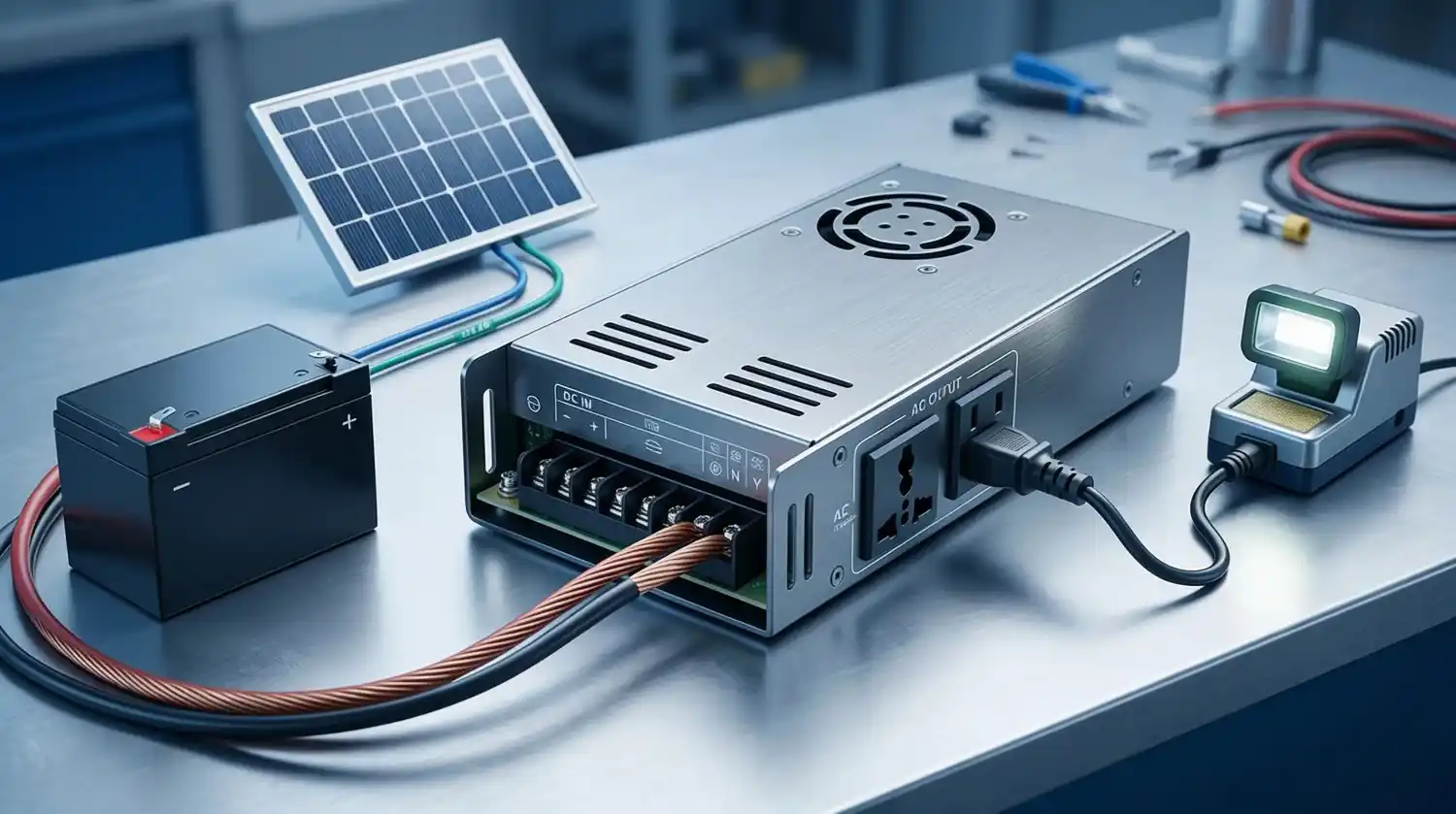
Suppose you are going camping and a small fan, a phone, and a computer are needed. That‘s where a DC to AC Converter comes in. It converts the direct current stored in batteries to alternating current used in many household appliances. From a beginner to a professional, finding the appropriate power supply in different situations can be crucial. Sometimes you may need a DC to AC Converter for backup power systems or applications that involve renewable energy sources.
What is a Converter? How do They Function? DC to AC Converter
A converter is an electrical device that converts one form of electrical power into another in order to match the needs of various equipment. The most common uses of converters are in electronic and power systems for controlling voltage, frequency or type of current. They do this using an electronic switch, control circuits, and a transformer.
A DC-to-AC converter (inverter) converts a direct current (DC) source (battery, solar panels, etc.) into a standard alternating current source used by most modern houses and factories. The inverter turns the supply on and off so quickly that it can be seen as a waveform. An inverter feeds a pure sine wave. They are widely used in renewable energy sources, backup power systems, DC to AC converter for car and portable power.
What are the Different Types of DC to AC Converters?
Here is the list of different types of DC to AC converters:
Pure Sine Wave Converter
This is a very clean and smooth power similar to utility electricity. It will work well with sensitive electronics, medical equipment, and newer appliances.
Modified Sine Wave Converter
The cheaper options are compatible with many popular devices such as DC to AC converter 1000 watt. It is ideal for lights, simple devices, and basic charging.
Square Wave Converter
Older and less popular, this type produces the simple output waveform. Most specialists favor the newer ones as they are more efficient and compatible with AC to DC Converter device name.
Power-Based Categories
Another method of grouping converters is by capacity. A 500-watt DC to AC converter will provide enough power for fairly light loads, whilst a 1000-watt DC to AC converter will be able to power heavier items for a longer time.
| Type | Output Quality | Cost Level | Common Use |
|---|---|---|---|
| Pure Sine Wave | Excellent | Higher | Electronics |
| Modified Sine Wave | Good | Medium | Home devices |
| Square Wave | Basic | Low | Limited equipment |
| High-Capacity Inverter | Varies | Medium to High | Heavy loads |
What Is the Working Principle of a DC to AC Converter?
Here is the workings of the process, it‘s actually simple to follow when you notice it.
- DC power is supplied to the converter by a battery, solar system or a vehicle.
- Electronic switches switch current direction very quickly.
- The internal circuits convert the signal into an alternating current.
- A transformer or control stage then adjusts the voltage if necessary.
- The standard is 115volts Alternating Current line.
There is a DC to AC converter 12V that is designed to take a twelve-volt battery and convert it into a standard 110 volts AC output. There is a large number of people who are in favor of having a DC to AC converter 220 volts because a few electrical devices have the same voltage.
Applications of DC to AC Converters
Understand the uses of DC to AC Converters:
Solar Energy Systems
A DC to AC Converter for Solar Panel applications converts the solar energy stored into electricity that can be used throughout the home. It is done so that the AC devices can run from solar batteries; otherwise, they cannot.
Cars and Travel
A car uses a DC to AC converter enables travelers to use their road trip devices while on the road. You can hook up your laptop, camera, and listen to your music- powering the entire time you are driving.
Home Backup Power
During outages, several families use converters. An inverter and a bank of batteries can power the lights, internet router and communication devices.
Industrial Operations
Factories and field sites often require portable power. Using converters allows equipment to be run in locations with minimal grid access.
Fun Fact: Most of these inverter technologies have been around long before today’s solar systems. Engineers initially design these various converter concepts mainly to meet the needs of a specific power application.
DC to AC Converter Ratings and Selection
The size is also crucial. Firstly, if we sum the power of all the machines we want to operate.
| Converter Rating | Suitable Devices | Typical Location | Benefit |
|---|---|---|---|
| 300 Watt | Chargers, lights | Travel | Portable |
| 500 Watt | Small appliances | Home use | Affordable |
| 1000 Watt | Tools, electronics | Backup systems | Higher capacity |
| 2000 watts and above | Multiple devices | Industrial use | Heavy operation |
Before you buy DC to AC converter equipment, check these points:
- Required wattage
- Input voltage
- Output voltage
- Safety protections
- Efficiency rating
- Brand support
Furthermore, the technical support from several DC to AC Converter suppliers makes a significant contribution to help identify the appropriate size can be identified to match current demand.
Did You Know? Some high-efficiency inverter systems are greater than 95 percent efficient, where less energy is stored as heat.
DC to AC Converter Circuit Basics
Just in a DC to AC converter circuit, there are switching devices, control circuitry, filtering, protection, etc., which combine to provide a steady source.
State-of-the-art electronic circuits use newer and more advanced semiconductor devices that naturally waste less energy. In the real world, more efficient circuit designs will tend to run cooler and offer increased performance. It is found that with more advanced switching techniques, the efficiency can be increased and the battery running time can be improved.
DC to AC Converter Price Factors
The DC to AC converter price depends on several factors such as how to convert AC to DC:
- Output power rating
- Waveform quality
- Brand reputation
- Safety features
- Build quality
- Warranty period
A pure sine wave unit generally costs more than a modified sine wave unit. Many users find that the higher cost provides a safer environment for more delicate equipment.
About S.S. Electronics
Established in 2004 and headquartered in Noida, Uttar Pradesh, India, S.S. Electronics is a reliable supplier and dealer of industrial automation and electrical products. With the guidance of Mr. K.D. Joshi and 20+ years of experience in this field, the company deals in power supplies, controllers, relays, connectors, energy meters, testing instruments, and many other automation products from top manufacturers across the globe. As an ISO 9001:2015 certified company, S.S. Electronics ensures top quality products, a competitive price range, good technical support and timely deliveries for their clients. Catering to panel builders, OEM's, system integrators, contractors all over India, S.S. Electronics thrive on integrity, reliability and customer satisfaction.
FAQs
Q1. How do a DC to AC Converter and an AC to DC Converter differ?
DC to AC Converter - Converts battery power into AC. AC to DC Converter - Converts an AC into DC for electronic and charging systems.
Q2. How do you call the AC-to-DC converter device?
People usually call it a rectifier or power supply, based on application and design.
Q3. Can a 12V DC to AC converter ‘220V run household appliances?
Yes. It can power compatible appliances through a converter if it has sufficient wattage and if the battery can handle the load.
Q4. How should I safely convert AC to DC?
Use either a suitably designed rectifier or a power supply that is regulated. Never connect equipment to the mains directly without the correct conversion device and any protection.
Q5. Here are some converters that are most convenient to use in solar systems
The vast majority of users opt for a pure sine wave model as the technology provides a more consistent power to run more types of appliances.
Q6. Why are DC-to-AC converters important in power systems?
DC-to-AC converters allow the use of AC appliances running on DC power sources and thus allow uninterrupted use during outages or in off-grid scenarios.
Q7. What are the available types of DC-to-AC converters?
Depending on the application and the equipment requirements, DC to AC converters can be pure sine wave or modified sine wave converters of varying capacity and output.
Conclusion
The key to a reliable power source is conformance to the applicable conversion technology. A DC to AC Converter takes the energy that has been stored and turns it into useful electricity in your home, car, office and Renewable Energy installations. By understanding which type you require, its operation, rating, circuitry, the points of purchase, we can make informed decisions and avoid expensive mistakes. We compare our power requirements and specifications charts, purchasing from a department store or quality provider. The convenient use of a reliable converter could be just what you need when the power is out.
Apart from that, proper installation, ventilation and regular maintenance have the obvious advantage of increasing safety, ensuring longer operating times for the machinery, reducing energy losses and ensuring long-term reliability.
Prepared to rewire your electricity? Come in and look at the high quality of converter range of S.S. Electronics and choose the right converter for your precise energy requirements. Contact Us Today!