

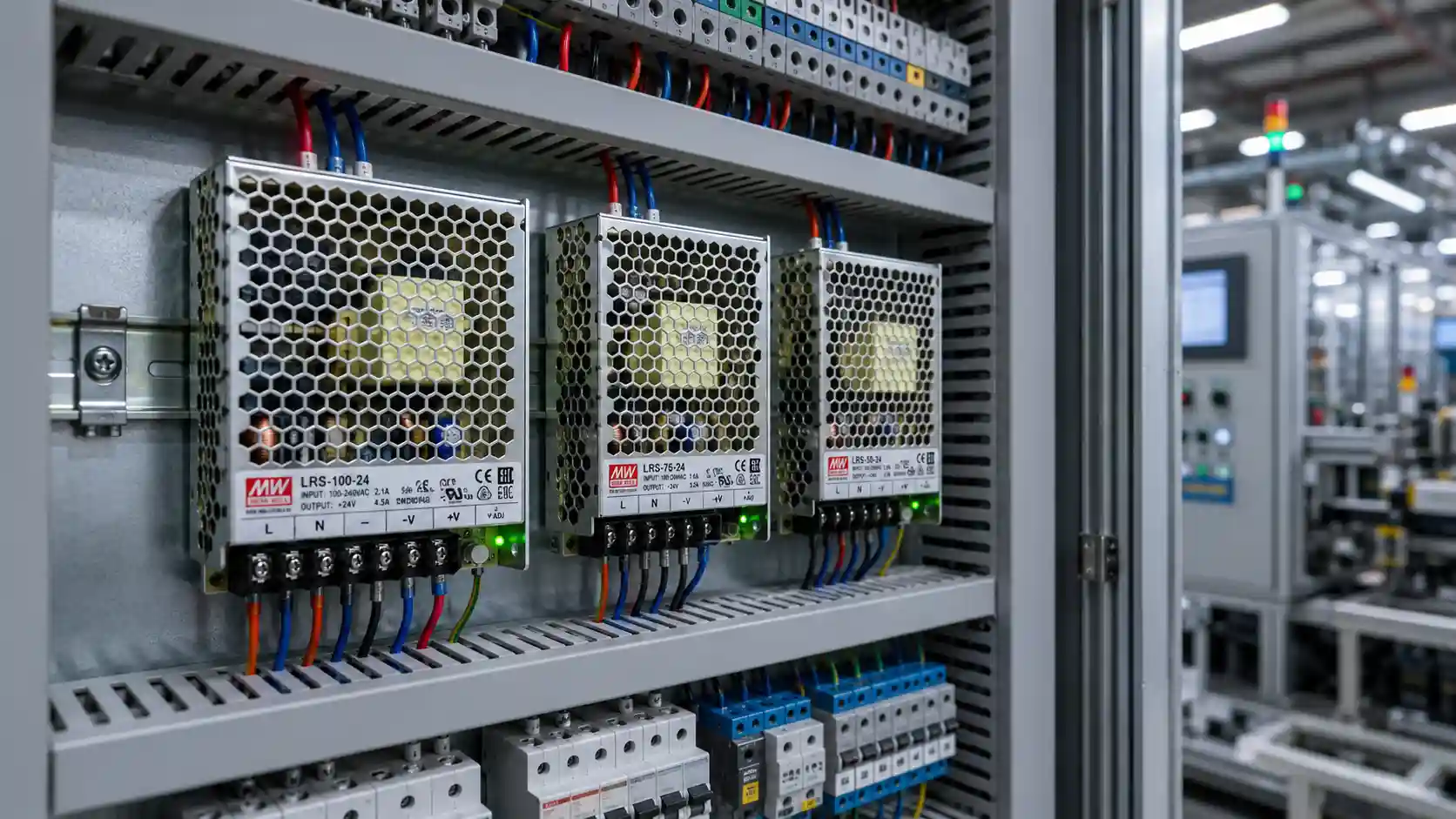
What actually matters when you're buying a Meanwell Power Supply — and what doesn't.
Panels fail for the dumbest reasons sometimes. Not bad wiring. Not faulty sensors. Just — the power supply couldn't keep up. A Meanwell Power Supply, picked correctly, does more than push current through a wire. Voltage stays put under load. Equipment downstream doesn't get fried the first time demand spikes. Pick badly, and you'll know soon enough: trips for no reason, panels running hot, parts giving out early. None of that's fun to troubleshoot at 2 AM. Before you commit to an Industrial Power Supply, a bit of homework saves a lot of that grief later.
Understanding Meanwell Power Supply and Its Importance
A Meanwell Power Supply is, at its core, a switching-mode unit — it takes AC mains input and turns it into clean, regulated DC output for industrial and electronic gear. Older linear units did the same job, just clunkier — bigger, hotter, wasteful. A Switching Mode Power Supply gets there through high-frequency switching instead, which is basically why it can be a third of the size and still run cooler. In a crowded panel where equipment runs around the clock, that difference adds up. Sensors, PLCs, drives, controllers — none of them forgive a power stage that can't hold tight voltage tolerances when the load shifts.
Why Meanwell Power Supply Is Preferred for Industrial Applications
Ask any panel builder why they keep coming back to Meanwell, and you'll hear some version of the same list:
- High conversion efficiency — less heat, lower running cost
- Compact, space-saving builds for panels where every inch counts
- Long operational lifespan, even under nonstop duty cycles
- Compliance with international safety and EMC standards
- A product range wide enough that sourcing from SS Electronics, a trusted Meanwell SMPS Supplier, for an Industrial Meanwell Power Supply rarely means compromising on specifications.
|
Did You Know? Meanwell's been at this since 1982, and today they produce well over 10,000 standard models — genuinely one of the widest ranges out there. Which is exactly why matching the exact spec to your application matters so much. |
Key Factors to Consider Before Buying a Meanwell Power Supply
Here's the thing — not every unit that fits on the DIN rail is actually right for your panel. A proper Meanwell Power Supply Buying Guide needs to cover electrical matching, physical fit, efficiency, and safety all together, because a unit can tick one box and still fail another. What follows is what we'd actually check before placing an order, so you're not swapping out the unit six months later.
Check Required Output Voltage and Current Rating
Start with the basics: what's the exact voltage and current draw of the equipment you're feeding? A Meanwell Power Supply has to match that load — PLCs, sensors, controllers, automation modules — precisely. Even a small mismatch in a DC Power Supply can mean instability, random resets, or slow damage to sensitive electronics down the line.
Select the Correct Wattage Capacity
Add up what every connected device actually pulls, then pick an Industrial Power Supply with some headroom above that — 20 to 30% is the usual rule, rather than something running flat-out at its rated max. That margin on a Meanwell SMPS is what keeps things stable through startup surges or unexpected peak loads.
Consider Efficiency and Energy Performance
The higher the efficiency rating, the less energy gets wasted as heat — and that shows up directly in panel temperature and running cost over time. A High Efficiency Power Supply tends to last longer too, simply because there's less internal heat stressing the components. Worth keeping in mind when you're comparing any Meanwell Power Supply meant for continuous-duty work.
Evaluate Protection Features and Safety Standards
A unit worth buying should have these built in — not bolted on as an afterthought:
- Overload protection to limit current during fault conditions
- Short circuit protection, with automatic recovery once the fault's cleared
- Overvoltage protection for the electronics downstream
- Thermal protection, shutting down before internal parts take damage
- This, really, is what separates a genuinely Reliable Power Supply from a cheap knockoff — ask any established Industrial SMPS Supplier to confirm certification on each one before you buy
Different Types of Meanwell Power Supply for Industrial Requirements
Meanwell doesn't just make one shape of power supply — there are several physical formats, and each one's built for a different kind of installation. Getting the format right matters almost as much as getting the voltage right; mounting space, ventilation, enclosure needs, they all vary by application. An experienced Meanwell Power Supply Supplier can usually tell within minutes which format actually fits your layout.
DIN Rail Mounted Power Supply
Snaps directly onto standard rail hardware inside electrical enclosures. DIN Rail Power Supply units are pretty much the default for PLC-based systems — slim, tool-free to mount, and they slot neatly into organised Control Panel Power Supply layouts where rail space is already at a premium.
Enclosed Type Power Supply
Fully housed in metal casing. An Enclosed Power Supply gives extra protection against dust, accidental contact, and general knocks — which is exactly why it suits machinery out on a harsher factory floor. A common go-to for demanding Industrial SMPS installations.
Open Frame Power Supply
No outer casing at all. An Open Frame Power Supply is meant to sit inside another equipment housing — a machine cabinet, an OEM device — where the surrounding enclosure already does the protecting, and you save on assembly cost besides.
Quick Comparison: Meanwell Power Supply Formats
| Type | Best Suited For | Key Advantage |
|---|---|---|
| DIN Rail | Control panels, PLC systems | Tool-free rail mounting |
| Enclosed | Machinery, factory-floor use | Extra dust and contact protection |
| Open Frame | OEM equipment, embedded systems | Compact, cost-efficient integration |
Applications of Meanwell Power Supply Across Industries
Why does this brand show up in so many unrelated industries? Because the versatility of Meanwell Power Supply Applications runs from heavy manufacturing all the way to commercial electronics. Pick the right type and rating once, and the same product family covers a surprising range of needs.
Industrial Automation and Control Panels
An Industrial Automation Power Supply is the backbone here — powering PLCs, sensors, controllers, and HMI systems that simply can't afford to go offline mid-process.
Machinery, Electronics and OEM Equipment
Custom machinery, standard electronic devices, doesn't matter — an OEM Power Supply from a trusted Meanwell Supplier lets manufacturers skip designing their own conversion circuitry and just build on something proven.
LED, Telecom and Other Commercial Applications
It's not all heavy industry, either. Meanwell Power Supply India installations turn up in LED lighting, communication equipment, and plenty of commercial setups that just need steady, regulated DC output.
|
Trivia Every Meanwell unit's switching circuit flicks on and off tens of thousands of times a second — way faster than you could ever notice. Brick-sized transformer, shrunk down to matchbox. That's the whole trick. |
Common Mistakes to Avoid When Choosing a Meanwell Power Supply
Two mistakes, really. That's most of what goes wrong with Meanwell Power Supply Selection — even for buyers who've done this before. Both are easy to dodge once you know they're there.
Choosing Based Only on Price
That cheapest unit on paper? It often costs more in the end — downtime, replacements, damaged equipment add up fast. A genuinely Reliable Power Supply Supplier will steer you toward the best lifecycle cost, not just the lowest number on the invoice.
Ignoring Environmental Conditions
Ambient temperature, ventilation, humidity, how much space you've got — all of it affects performance over time. An Industrial Power Supply rated for a controlled office won't hold up the same way on an unventilated factory floor.
|
Fact Here's a number worth remembering: every 10°C rise above a power supply's rated operating range can roughly halve the lifespan of its internal capacitors. Environmental conditions really do deserve as much attention as the electrical spec sheet. |
Why Choose SS Electronics for Meanwell Power Supply Solutions?
SS Electronics works as an industrial automation supplier — genuine Meanwell products, and a team that actually understands panel and machine requirements rather than just selling off a catalogue. As an established Meanwell Power Supply Supplier, they'll help you match voltage, wattage, and mounting type correctly the first time round, which saves the whole trial-and-error headache. Add dependable stock and responsive support, and it's easy to see why SS Electronics is a trusted Industrial Automation Supplier for panel builders, OEMs, and maintenance teams who just want genuine parts without the wait.
Choose the Right Meanwell Power Supply for Reliable Performance
So, what's it actually come down to? Matching voltage and wattage on your Meanwell Power Supply. Not skimping on efficiency or protection. Getting the mounting format right. And being honest about where the thing's actually going to live — dusty factory floor or clean office panel, doesn't matter, just be honest about it. Miss any of that and you're setting up downtime you could've avoided with an afternoon of planning. Work with an experienced Meanwell SMPS Supplier, and most of this stops being a guessing game — you get power your system can actually depend on.
FAQs
1. What is a Meanwell Power Supply used for?
Ans: Simple enough — it takes AC mains power and turns it into steady, regulated DC. That's what runs your PLCs, sensors, controllers, automation modules, even LED setups. The switching-mode design keeps it compact and efficient, holding voltage steady no matter how the load shifts. Older linear supplies just can't compete on that front.
2. How do I choose the right wattage for my application?
Ans: Add up what every connected device actually draws, then build in 20-30% headroom above that number — don't cut it close. That margin's what stops overheating during startup surges or sudden peak loads. Run a unit flat-out at its max rating day after day, and you're just shortening its life. Leave the buffer.
3. What is the difference between DIN rail, enclosed, and open frame types?
Ans: DIN rail units clip straight onto control panel rails — the standard pick for PLC setups. Enclosed types come wrapped in metal casing, built for rougher factory environments. Open frame units skip the casing altogether; they're meant to sit inside another equipment housing, like OEM machinery, where protection's already built in elsewhere.
4. Why is efficiency important in an industrial power supply?
Ans: Less efficiency means more wasted energy — and that shows up as heat, which drives panel temperatures up and running costs with them. A more efficient unit also tends to outlast a less efficient one, simply because there's less internal stress on components like capacitors. For continuous-duty setups, that difference really adds up.
5. What protection features should a reliable power supply have
Ans: Four things, really — overload protection, short circuit protection with automatic recovery, overvoltage protection, and thermal shutdown. Skip any of those and you're gambling with both the unit and whatever's connected to it. A supply that doesn't have these built in as standard is far more likely to fail without warning.
6. Does the environment affect power supply performance?
Ans: It does, more than people expect. Ambient temperature, ventilation, humidity, how much room there is to breathe — all of it changes how a unit holds up over time. A supply rated for a clean office won't necessarily survive an unventilated factory floor. Match the rating to the real conditions, not the ideal ones.