

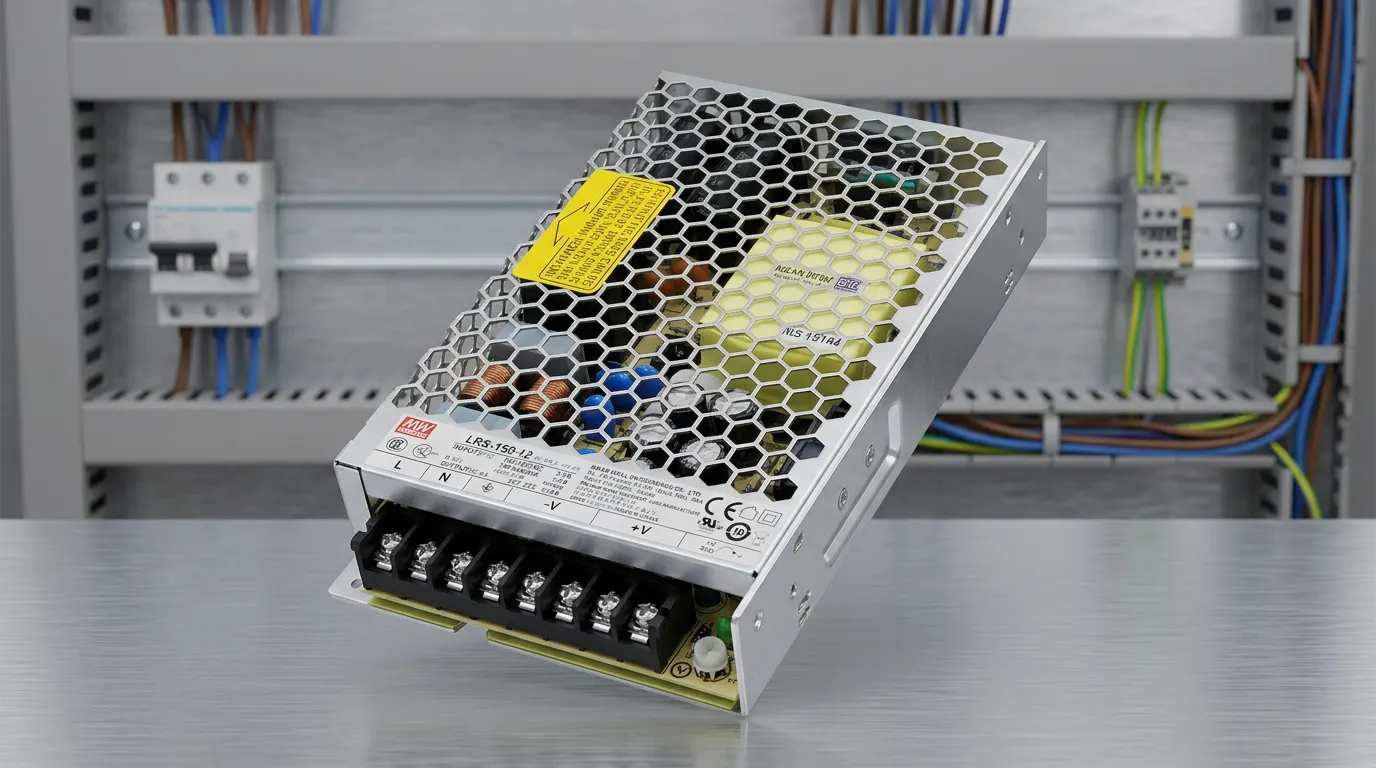
Walk into any control panel or LED setup running in an Indian factory, and there's one part quietly doing the heavy lifting — a stable power converter. Ask an electrical engineer what keeps things running when the mains voltage isn't behaving, and they'll point to a good SMPS. That's what this blog is about: what it is, how it functions, the types you'll come across, and why a genuine Meanwell SMPS unit beats a generic one every time.
Small panel or a full production line — doesn't matter. The power hardware you pick decides how consistently things run. One weak unit, and the effects ripple outward — sensors act up, drives misbehave, monitoring goes haywire. Worth getting this right before it becomes a bigger headache.
What Is an SMPS?
The SMPS full form is Switched Mode Power Supply. In simple terms — a circuit that takes messy AC or unregulated DC and turns it into clean, steady DC output. Older transformer-based units did this too, just not efficiently. A SMPS power supply instead switches at high frequency through transistors, so less heat, less bulk, better regulation.
Higher switching frequency means the internal transformer and other parts can be smaller. That's really the whole reason panel builders across India have moved toward compact, lightweight units instead of the older, bulkier linear designs — space in an enclosure is never unlimited.
Why Is It Important?
Industrial electronics don't handle voltage spikes, sags, or line noise well — especially at sites where grid conditions swing a lot. A good power unit sits between the mains and your equipment, absorbing that mess before it reaches your PLCs, sensors, and drives.
A reliable SMPS supply keeps things running longer, plain and simple. Get a poorly regulated or fake unit in there, and you'll see nuisance trips, weird sensor readings, sometimes a full shutdown — and that means lost production time. Add up the downtime and the repeated replacements, and whatever you "saved" on a cheap unregulated supply gets wiped out fast.
|
Did You Know: A good switching unit can run nearly twice as efficient as an old linear transformer supply. |
Types of SMPS
Switching power supplies usually get grouped by mounting style, output capacity, and where they're used. Makes it easier to shortlist a family first, then narrow down to a model. Here's the rundown:
- Enclosed general-purpose units — compact, metal-cased, good for control panels and light machinery.
- DIN rail mount units — slim, built for cabinets, PLC panels, automation racks.
- High-power industrial units — rugged builds for continuous-duty, high-load work.
- LED driver units — dedicated to delivering steady current for lighting.
- DC-DC converters and DC-AC inverters — for voltage conversion inside embedded and control setups.
|
Fact: High-frequency switching is the whole reason modern supplies fit in a fraction of the space older ones needed. |
Features to Look For
Picking the right unit isn't just matching voltage and current numbers on a spec sheet. A few things decide how well it holds up over time:
- Input voltage tolerance — needs to handle a fluctuating grid, not just a clean lab supply.
- Protection features. Short circuit, overload, over-voltage — non-negotiable.
- Ambient operating temperature range that actually fits where it'll sit.
- Mounting format — enclosed, open-frame, or DIN rail, whatever matches the panel.
- Certification and build quality — this is how you confirm it's genuine, not a knockoff.
Meanwell SMPS — Product Overview
Among global manufacturers, Meanwell SMPS units have earned a name for consistency and long service life — not just marketing talk, this is what panel builders actually report. The lineup covers enclosed general-purpose supplies, DIN rail units for cabinets, high-power supplies for heavier loads, and LED driver models. Pretty much every industrial power need, one trusted family.
If you're comparing SMPS price across vendors, here's the thing — the invoice number matters less than the channel it came through. A genuine unit is what actually determines how long your panel runs without a hitch. And sticking with one trusted brand across projects beats juggling five unfamiliar suppliers every time a new panel comes up.
Benefits of Genuine Meanwell SMPS
Here are the benefits for Meanwell SMPS Wholesalers in India :
- Stable output that doesn't flinch during voltage swings.
- Less heat than linear alternatives — better SMPS working efficiency overall.
- Small footprint, so panel space isn't wasted.
- Long lifespan — fewer replacements down the line.
- Built-in protection that keeps connected gear safe.
Industrial Applications
These units show up in more places than people realise — anywhere consistent, uninterrupted power matters:
- PLC panels, CNC machines, factory automation lines.
- LED lighting for commercial spaces and infrastructure work.
- Telecom and networking gear that needs a steady DC rail.
- Medical and lab instrumentation.
- Renewable energy setups — solar monitoring, control systems, that sort of thing.
|
Trivia: Switching power designs actually started in aerospace, back when saving weight and heat mattered more than anything else. |
General Comparison: Power Supply Types at a Glance
Here's a general look at how common power supply categories stack up on efficiency and typical use — not size, not pricing.
| Power Supply Type | Efficiency | Size & Weight | Best Suited For |
|---|---|---|---|
| Conventional Linear Supply | Low (40–60%) | Bulky, heavy transformer-based | Simple, low-noise analog circuits |
| Standard Enclosed SMPS | High (75–85%) | Compact, lightweight | Control panels, general automation |
| DIN Rail Mount SMPS | High (80–90%) | Slim, space-saving | PLC panels, cabinet installations |
| High-Power Industrial SMPS | High (85%+) | Rugged, heat-sink design | Continuous-duty heavy machinery |
| LED Driver SMPS | High (85–90%) | Compact, sealed options | LED lighting and signage systems |
Expert Tips / Buying Guide
A few practical checks before you finalise anything — especially if it's a multi-panel order or a recurring supply arrangement:
- Verify the source first. Going through authorised Meanwell SMPS Suppliers in India cuts the risk of a counterfeit unit slipping into your build.
- Match load calculations properly — undersized units just don't last.
- Doing bulk or project-based buying? Established wholesalers usually have better stock consistency and paperwork sorted.
- Get the technical datasheet before locking in any model.
- For repeat orders, a dependable Meanwell SMPS Stockist in India means faster turnaround, no chasing stock every time.
S.S. Electronics
Established in 2004 and headquartered in Noida, Uttar Pradesh, India, S.S. Electronics is a reliable supplier and dealer of industrial automation and electrical products. With the guidance of Mr. K.D. Joshi and 20+ years of experience in this field, the company deals in power supplies, controllers, relays, connectors, energy meters, testing instruments, and many other automation products from top manufacturers across the globe. As an ISO 9001:2015 certified company, S.S. Electronics ensures top quality products, a competitive price range, good technical support and timely deliveries for their clients. Catering to panel builders, OEM's, system integrators, contractors all over India, S.S. Electronics thrive on integrity, reliability and customer satisfaction.
FAQs
1. What is SMPS?
Ans: An SMPS is basically a circuit that takes AC or unregulated DC and turns it into clean, steady DC output — using high-frequency switching instead of a bulky transformer. That's why it runs cooler, takes up less space, and holds voltage steady even when the incoming supply isn't behaving. Pretty much the standard now for industrial setups.
2. What does SMPS stand for?
Ans: Switched Mode Power Supply — that's the SMPS full form. The "switched mode" part is the key bit. Instead of regulating voltage continuously like older linear supplies, it switches on and off rapidly through transistors. Less wasted energy, less heat, and a much smaller footprint for the same output power.
3. How does an SMPS actually work?
Ans: It starts with converting incoming AC to DC, then chops that DC into a high-frequency pulse using switching transistors. That pulse gets stepped down through a small transformer, then smoothed back into a clean DC output. A feedback loop keeps watching the output and adjusting things so voltage stays stable no matter what's happening upstream.
4. Why go with a Meanwell SMPS instead of a cheaper option?
Ans: Genuine meanwell SMPS units are built to hold up — consistent quality, proper certifications, longer service life. A cheap unbranded unit might work fine for a week, then start causing nuisance trips or damaging connected equipment. The upfront saving rarely covers what you'll spend later on downtime and replacements.
5. What affects SMPS price?
Ans: A few things really — output rating, mounting type, protection features built in, and whether it's properly certified. Genuine branded units usually cost more than unverified ones upfront, but they fail less often and need way less maintenance. Over the life of a panel, that difference in SMPS price tends to even out.
6. Where do I get genuine Meanwell SMPS in India?
Ans: Best bet is going through authorised channels — established Meanwell SMPS Suppliers, Wholesalers, or Stockists in India who source directly and keep proper documentation. Skipping that route to save a little upfront is how counterfeit units end up in panels. Stick with verified sourcing and you avoid that risk entirely.
Conclusion
A dependable power conversion unit is really the backbone behind every automation system, lighting job, and control panel out there. Knowing the SMPS full form, how it works, and what types exist — that's what separates an informed decision from just picking whatever's cheapest and unbranded. Go with trusted Meanwell SMPS Dealers in India, and your project runs on hardware that's genuine, well-supported, and built for how the grid actually behaves here.
Automation keeps scaling up, infrastructure keeps getting smarter — and the demand for solid, well-documented power hardware isn't slowing down. Getting the sourcing right today is really just protecting tomorrow's uptime.
| Need genuine, industrial-grade power solutions? Contact with S.S. Electronics for expert guidance on the right SMPS for your setup. |