

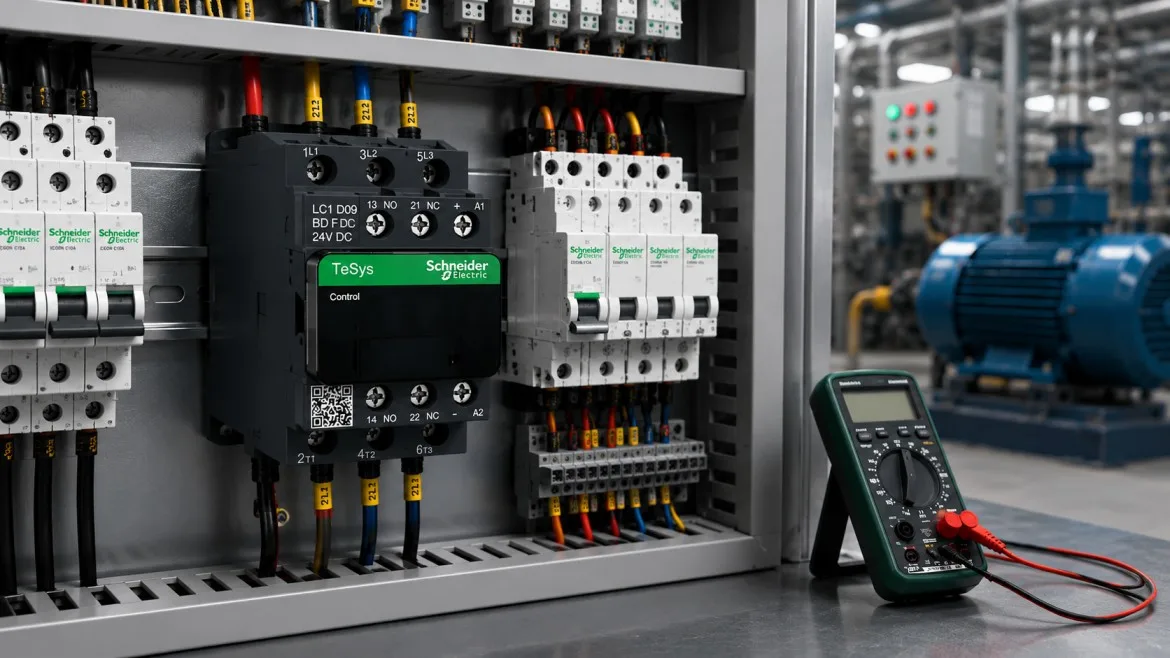
A practical guide to picking the right Schneider Electric Contactor for motor control, switching, and industrial automation panels
Which contactor is the right one for your load? It is the question any panel maker has to confront at some point in time. On the surface, an electrical contactor may seem simple – coil goes in, contacts close; but mismatch between the current and/or coil voltages could easily bring a production line to a standstill within days. The following guide explains how contactors are selected, how the design of a 3 phase contactor diverges from the single phase one, and how a Schneider Contactor integrates into panel construction.
Apart from specifications, availability is a critical consideration. After all, a contactor which cannot be readily replaced in case of failure is pointless for choosing a reliable manufacturer in the first place, so sources of these parts will be identified on the way.
What Is an Electrical Contactor?
An electrical contactor is an electromechanical switch designed for circuit making and breaking of power circuits used for motors, lighting systems, heating systems, capacitor banks and other equipment. How does it differ from a standard switch? With remote operation possible via a coil, an operator or automation system can control a large load without having to deal with contacts directly.
- A coil, a set of main contacts, and auxiliary contacts make up the basic build
- Current, voltage, and utilisation category, think AC-1 or AC-3, determine the rating
- Choose an AC contactor or a DC contactor depending on what supplies the coil
- Starters, panels, and motor control centres all rely on this switching core
Why Contactor Selection Matters
A contactor rarely fails the moment it is undersized. It wears down slowly, overheating contacts, a coil that starts chattering, contacts pitting faster than they should, and by the time something trips on the panel, replacing it usually costs more than getting the spec right at the start.
- Nuisance tripping drops off once the current rating actually matches the load
- Frequent motor starts cause less arcing and pitting on properly rated contacts
- Coil power draw stays predictable across the panel
- Downtime on production-critical motor circuits becomes far less likely
- Panel safety and insulation compliance gets easier to maintain
Types and Variants of Contactors
Pole configuration and switching duty are what really separate one contactor type from another, and each suits a different corner of the panel.
- 3 pole contactor: the default for three-phase motor circuits, since it switches all three line conductors together.
- Need to isolate the neutral too? That is where a 4 pole contactor comes in, common in changeover and star-delta setups.
- A motor contactor is purpose-built for AC-3 duty, handling starting current and inrush without derating.
- Lighting circuits and capacitor switching usually call for a definite purpose contactor instead.
- Long-duration loads do not need continuous coil power at all when a latching contactor is holding the contact position.
Features to Look For Before Buying
Most of what a buyer needs sits right there on the nameplate, but a handful of specifications deserve a closer look before an order goes out, especially on panels running around the clock.
- Does the current rating, or Ie, match or exceed the load's full current, with room for starting current? Check this first.
- Coil voltage has to line up with the panel's control circuit, not the main supply.
- AC-3 suits motors, AC-1 suits resistive loads, and mixing up the utilisation category shortens contact life fast.
- Standard motor loads call for a 3 pole contactor, a switched neutral calls for a 4 pole contactor.
- Interlocking and status feedback depend on having the right NO and NC auxiliary contact blocks.
- DIN rail compatibility and physical footprint decide whether it actually fits the enclosure.
Product Overview: Schneider Electric Contactor Range
Built to standard IEC ratings, a Schneider Electric Contactor gets specified across a lot of Indian panel-building and OEM work simply because the build quality and performance data hold up. The Schneider TeSys D Contactor series covers general-purpose motor control especially well, with current ratings that scale from small auxiliary loads right up to heavier three-phase motors.
Multiple voltage options come standard with the Schneider contactor coil, which lets designers standardise control voltage across a board without adding extra transformers. Sourcing at scale? Working with established Schneider Electric Contactor Suppliers in India keeps lead times consistent and parts traceable. SS Electronics carries this range and can help match the selection to the actual load profile of a project, a single-pump starter or a larger board handling several motor feeders, either way.
Key Benefits of Using Schneider Contactors
Here are the major benefits:
- Switching life holds up across repeated motor start-stop cycles
- Coil behaviour stays predictable, which simplifies control circuit design
- Current ratings span small loads through large motors
- Standard accessory blocks and overload relays fit without adaptation
- Datasheets are documented well enough to ease panel certification
Applications and Use Cases
Schneider Electric Contactors turn up across a wide range of industrial and commercial settings, not only heavy manufacturing floors.
- Pumps, fans, compressors, and conveyors all rely on motor starters built around them
- Star-delta and reversing starter circuits need a 3 phase contactor to function
- Warehouse and large commercial lighting circuits use them as lighting contactors
- Power factor correction panels use them for capacitor bank switching
- Compact AC contactor footprints suit HVAC control panels particularly well
- Continuous-duty motors in water treatment and process plants depend on them too
|
TRIVIA Contactor traces back to the simple idea of making contact. Early twentieth-century electricians used the word for any device that closed a circuit remotely, well before coil-operated switching became the norm. |
Comparison: Contactor Types at a Glance
Understand the types of contactors with the following table:
| Parameter | AC Contactor | Motor Contactor (AC-3) | Latching Contactor |
|---|---|---|---|
| Primary Use | Lighting and heating circuits, general switching | Starting and running motors | Holding long-duration loads |
| Coil Power Draw | Draws power the whole time it's energised | Same continuous draw as an AC contactor | Draws power only during the switch, then drops to zero |
| Typical Poles | Usually 3 or 4 | Almost always 3 | Ranges from 2 to 4 |
| Switching Duty | Light to moderate | Frequent starts, heavy inrush | Rarely switched |
| Common Panel Role | Feeder or auxiliary circuits | Motor control centres | Standby banks, lighting |
Expert Tips for Buying the Right Contactor
Here are the expert tips for buying the suitable contactor:
- Size for the motor's full load current plus a margin, not just the nameplate horsepower
- Coil voltage should match the actual control transformer output, never assume a standard
- Frequent switching applications need a look at the mechanical and electrical life-cycle ratings
- Keep a few spare auxiliary contact blocks around for interlocking changes down the line
- Counterfeit stock is a real risk, so buy only from verified Schneider Electric Contactor Dealers in India
- Multi-panel projects usually work out cheaper sourced through recognised Schneider Electric Contactor Wholesalers in India
|
FACT The AC-3 utilisation category is what rates a standard three-phase induction motor contactor. It covers starting, running, and breaking squirrel-cage motors under load, specifically. |
About S.S. Electronics
Established in 2004 and headquartered in Noida, Uttar Pradesh, India, S.S. Electronics is a reliable supplier and dealer of industrial automation and electrical products. With the guidance of Mr. K.D. Joshi and 20+ years of experience in this field, the company deals in power supplies, controllers, relays, connectors, energy meters, testing instruments, and many other automation products from top manufacturers across the globe. As an ISO 9001:2015 certified company, S.S. Electronics ensures top quality products, a competitive price range, good technical support and timely deliveries for their clients. Catering to panel builders, OEM's, system integrators, contractors all over India, S.S. Electronics thrive on integrity, reliability and customer satisfaction.
FAQs
1. How do I know which current rating I actually need for my contactor?
Ans: Honestly, start with the load's actual running current — not the horsepower stamped on the motor's nameplate. Those two numbers aren't the same thing. Leave room for starting current too, because motors pull more when they kick on than once they're running steady. Cut that margin too close and you'll be dealing with nuisance trips and worn contacts sooner than you'd like.
2. What's the difference between a 3 pole and 4 pole contactor?
Ans: A 3 pole handles all three line conductors at once, which covers most standard three-phase motor setups just fine. Go with a 4 pole when the neutral needs switching too — think changeover systems or star-delta arrangements, where isolating the neutral isn't optional. It really comes down to whether your circuit needs that extra pole or not.
3. Does coil voltage need to match my main power supply?
Ans: Actually, no — and this is where a lot of people get tripped up. The coil voltage needs to match your control circuit, not the incoming main supply. Schneider builds in multiple coil voltage options for exactly this reason, so panel builders can keep one control voltage standard across the whole board instead of adding extra step-down transformers.
4. Why does AC-1 vs AC-3 utilisation category actually matter?
Ans: These two aren't just labels — they describe how the contactor's meant to switch. AC-3 is built specifically for motors: starting, running, breaking squirrel-cage loads under load. AC-1 is for resistive stuff, like heaters. Use an AC-1 rated unit on a motor and you'll burn through contact life fast, thanks to arcing and pitting it wasn't built to handle.
5. What makes a latching contactor different from a regular one?
Ans: A standard contactor keeps drawing coil power the whole time it's energised — that adds up if the load runs for hours. A latching version only pulls power during the actual switch, then sits at zero while holding its position. For standby banks or lighting that's on for long stretches, that difference in power draw is worth considering.
6. Where should I actually source a Schneider Electric Contactor from?
Ans: Specs only get you so far if you can't actually get the part when something fails. Sticking with verified Schneider Electric Contactor Dealers or established Suppliers in India keeps lead times steady and stock traceable — and cuts down the risk of counterfeit units. SS Electronics stocks the range and can help match it to your actual load.
Conclusion
Three things decide whether an electrical contactor is right for the job: does the current rating match the load, does the coil voltage line up with the control circuit, and is the pole configuration correct for the switching duty? A Schneider Electric Contactor, the TeSys D range especially, holds up reliably across most industrial and commercial panels, as long as utilisation category and duty cycle get the same attention as nameplate current. Skip that step, and the wiring diagram usually gets revisited sooner than planned.
Get the Right Contactor for Your Panel
| Need a genuine Schneider Electric Contactor with real selection support behind it? Reach out to SS Electronics and get the next panel wired right. |