

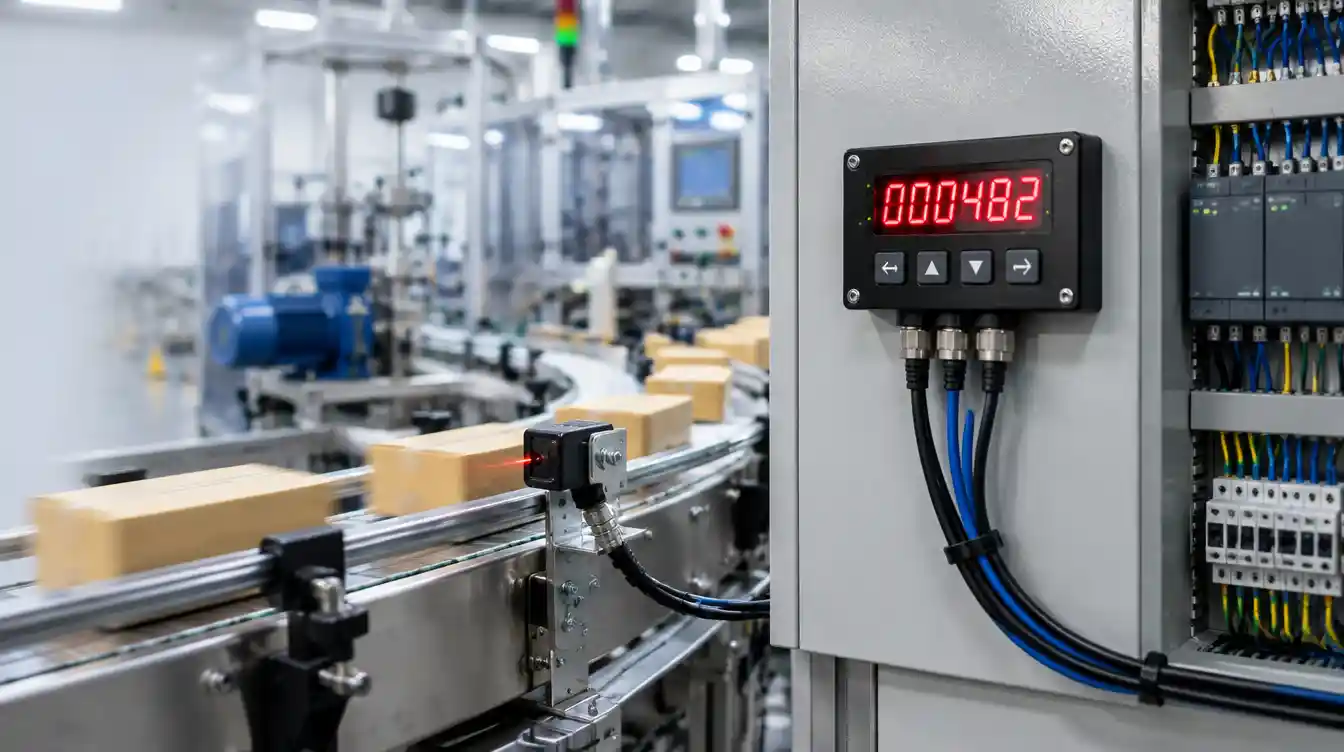
Most factory floors run on counting, even if nobody talks about it much. A Selec Counter sits quietly on a panel keeping track of machine cycles, output numbers, batch totals and pulse signals, and it's usually the reason production reports come out clean instead of guessed at. Grabbing the first model available rarely works out well though. Input type, counting speed, display size, panel space — miss one of these and you're back at the supplier within weeks.
What Is a Selec Counter?
A Selec Counter counts events, plain and simple — product units, machine cycles, pulses, whatever the line generates. A Selec Digital Counter can be set to count up, count down, or handle batches, and it pulls its data from sensors, switches or encoders wired into the process. It looks like a small box on a panel. What it actually does is carry a fair amount of the accuracy for anything repetitive.
How Does a Selec Counter Work?
Think of it as a loop. An event happens, the counter receives a signal — a pulse, a contact closure, a sensor trigger — adds it to the running total, and pushes the new number onto the display within a fraction of a second. That's an Electronic Counter in a nutshell. No manual tally sheets, no clipboard, just the same loop repeating for as long as the line runs.
Where Are Selec Counters Used?
You'll find a Selec Counter almost anywhere a process repeats itself:
- Production and assembly lines, counting finished units
- Packaging equipment, tracking batch and pack sizes
- Conveyors, for item or length counts
- Automation panels, watching machine cycles
- Batch processing setups, controlling quantity
- Central control panels, for one view of the whole line
It's less about the industry and more about whether something needs counting on repeat.
Did You Know? Mechanical counters go back over 150 years — textile mills used them to track thread output long before electronics existed. The job hasn't changed much, just the accuracy.
Key Factors to Consider When Choosing a Selec Counter
Once the basics are clear, matching specs to your process is really what Selec Counter Selection comes down to.
Counter Type and Application
Figure out whats actually being counted before anything else — units, cycles, length or time behave differently. An up-counter, down-counter or preset counter each suit different jobs, so matching a Digital Counters function to the process now means youre not swapping hardware six months in.
Input Signal Compatibility
This is the step most people rush. Your sensors, proximity switches or encoders each output a specific signal type — NPN, PNP, voltage-free contact, pulse — and your Selec Digital Counter needs to support exactly that. A mismatched Counter Input Signal is probably the single biggest reason installations don't work on the first try.
Counting Speed and Range
Processes don't all move at the same speed, obviously, but people still forget to check this. Confirm the counter's maximum Counter Speed and range comfortably clear what your line actually produces — otherwise a Digital Counter starts missing pulses right when the line speeds up.
Display and Readability
An operator glancing at a panel from across the room needs digits they can actually see. Digit size, brightness, contrast on the Selec Counter Display all matter more than people expect. A sharp Selec Counter Meter means fewer misreads and faster calls on the floor.
Panel Size and Mounting Requirements
Cut-out size, depth behind the panel, mounting style — check all three before the order goes in, not after the counter arrives. A Panel Mount Counter that fits the first time saves a reworked panel and a delayed install.
Did You Know? Some counters keep their tally in non-volatile memory, so a power failure mid-shift doesn't erase anything — the count just picks back up once power's restored.
Benefits of Using a Digital Counter in Industrial Automation
A well-matched Digital Counter earns its space on the panel pretty fast:
- Real-time, accurate process monitoring
- Production tracking without constant manual checking
- Better visibility for operators at a glance
- Steadier batch control across shifts
- Clearer traceability through the whole process
None of this is dramatic on its own — it's the consistency across every shift that actually adds up.
Common Mistakes to Avoid When Selecting a Counter
A rushed decision here tends to show up as a compatibility problem later, and it's almost always one of these:
- Wrong input signal type for the sensors in use
- Underestimating the process's real counting speed
- Skipping the panel cut-out and mounting check
- An Industrial Counter display that's too small to read properly
- Buying before confirming full application compatibility
What to Check When Choosing a Selec Counter Supplier
The counter matters, but so does who's selling it. SS Electronics points to a few things worth checking before picking a Selec Counter Supplier: genuine sourcing with no shortcuts on quality, a model range wide enough to cover different applications, technical specs and datasheets that are actually clear, real guidance rather than a sales script, fair pricing on bulk orders, and support that sticks around once the sale is done.
As a trusted Selec Counter Dealer, SS Electronics has built a reputation as a dependable source for a Selec Counter in India, backed by genuine stock and support that's actually useful.
Conclusion
None of this is complicated once you break it down: input type, counting speed, display, panel fit. Get those four right and a Selec Counter will run without drama for years. Have a look through the range at SS Electronics, a Selec Counter Supplier that's set up to help you land on the right fit the first time round.
Frequently Asked Questions
1. What is a Selec Counter used for?
It's used to track events like product units, machine cycles, pulses or batch quantities across industrial equipment. A Selec Counter keeps automation systems counting accurately, removes most manual tracking errors, and gives operators a live view of what's happening on the floor throughout a shift.
2. How do I choose the right digital counter?
Start with input compatibility — does it match your sensors? Then check counting speed and range against your process, along with display readability and panel mounting size. Get those four sorted before you buy and a Digital Counter should perform reliably for years without much fuss.
3. Where are digital counters commonly installed?
Mostly on control panels, production equipment, packaging lines and conveyor systems. A Digital Counter also shows up on batch processing setups and automation panels — basically anywhere a process needs continuous, accurate counting instead of someone tracking numbers by hand on paper.
4. What input types does a Selec Digital Counter support?
Depending on the model, a Selec Digital Counter typically accepts NPN, PNP, voltage-free contact or pulse-type signals. Before installation, it's worth double-checking that your sensor or switch output actually matches — a mismatched signal type is one of the easiest and most avoidable setup mistakes.
5. Will a Selec Counter save data in case of power failure?
For the most part, yes. The Selec Counter with non-volatile memory retains its count despite sudden power failure. Consequently, nothing is lost during work shifts. When the power supply comes back on, the operator can simply continue from where he/she stopped.
6. Why should I buy from an authorized Selec Counter Dealer?
An authorized Selec Counter Dealer like SS Electronics gives you genuine products, correct specifications and application advice that's grounded in actual experience, not guesswork. It also cuts the risk of counterfeit units and keeps warranty and after-sales support properly intact down the line.
| Looking for a genuine Selec Counter for your industrial setup? Explore the complete range at SS Electronics — visit sselectronics.in |