

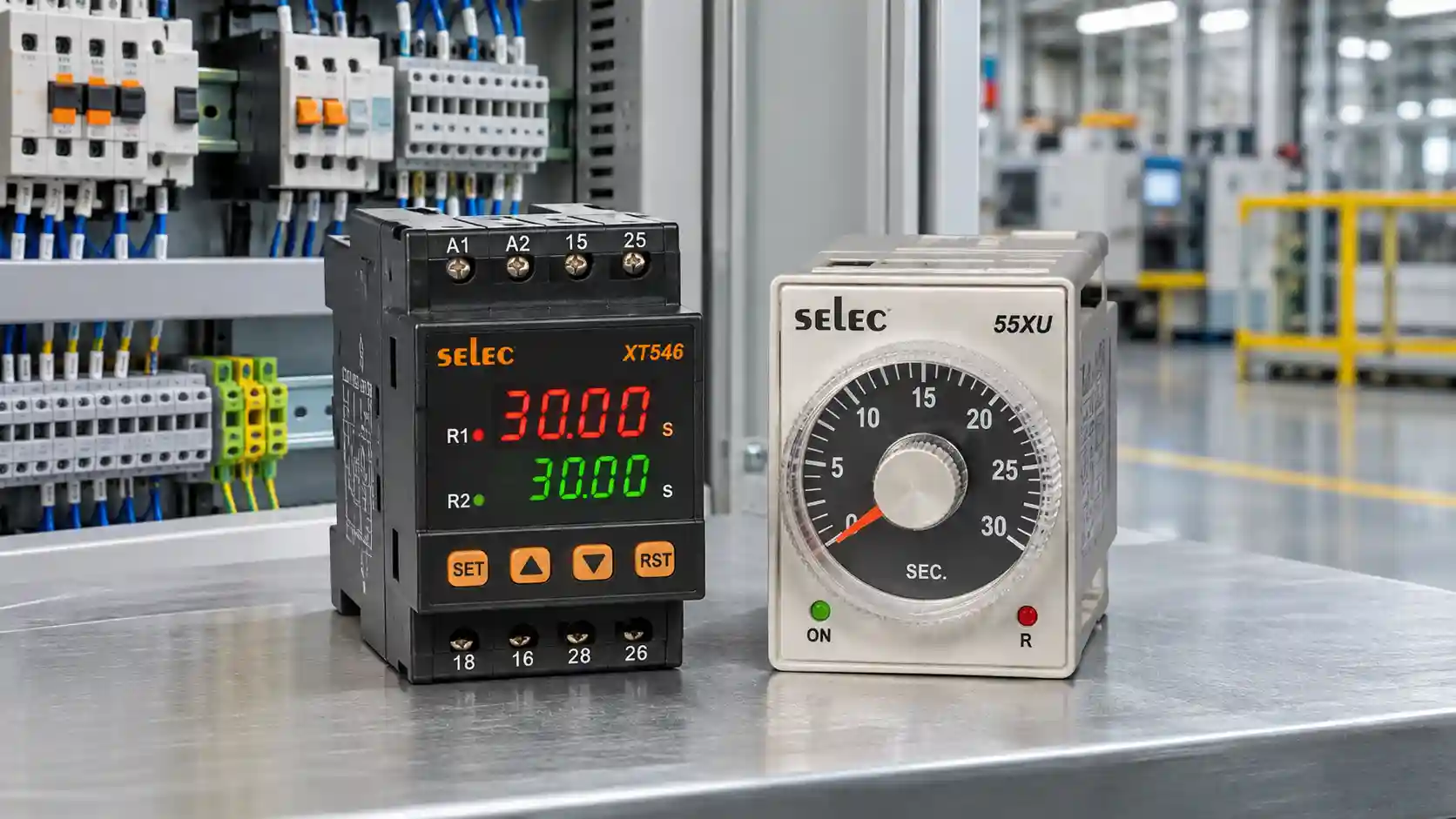
A plain-English comparison for panel builders and buyers.
Picking a timer sounds easy until you stand at a control panel holding two different options. SS Electronics hears this question from panel builders. The function of a Selec timer is to control the timing of a load’s turning on or off. Understanding Selec timer types because there are two types of timers, and either can be used; however, there is an ideal type for a specific panel. This is how to select an industrial timer relay.
What Is a Selec Timer and How Does It Work?
A Selec timer is a time-delay switch. You give it some delay, put supply, and it counts. After the delay time elapses, relay contacts operate and energize and de-energize an electric motor, valve, light, or an alarm. This type of Selec timer application is found in starters, conveyors, pumps, and packaging machinery since both what and when a certain action will take place become very significant.
The Selec timer working principle follows a simple sequence:
- Supply comes to the timer and the countdown starts.
- Countdown lasts for the time that was pre-programmed in advance.
- The contacts switch at the end of countdown.
- Switching off the supply or resetting command resets the cycle.
- The cycle restarts next time the timer starts.
What Is a Digital Selec Timer?
A Digital Selec timer pairs an electronic circuit with a display that shows the set time. You enter values with push buttons, not a dial. In most cases, the user is able to select a particular function and range from a menu; however, this varies from one device to another. The fact that the circuit is electronic means that it can perform some functions that a dial timer cannot; besides, it allows for accurate value input.
Key Features of Digital Selec Timers
These Digital Selec timer features stand out in a digital timer relay:
- A clear LED or LCD readout of set and running time.
- Several functions in one unit, such as on-delay, off-delay and flasher.
- Fine time steps, from fractions of a second up to hours on many models.
- Lockable settings on some models, so a passing hand cannot change a tuned value.
- Want the same setting on ten machines? Copying it is easy.
|
DID YOU KNOW?: One multifunction digital timer can often replace several single-function analog units in a panel. |
What Is an Analog Selec Timer?
An Analog Selec timer works with a knob and a printed scale. Pick a time range, turn the dial, done. No menu to learn, so a new technician can set it in seconds. It handles simple delays well and fits older panels. Many plants still run these timers on fans, pumps and lighting circuits because they are quick to replace and need no programming.
Key Features of Analog Selec Timers
These Analog selec timer features keep an analog timer relay in regular use:
- Dial setting against a visible scale
- Basic delay functions, with more on some models
- Quick manual changes, no keypad needed
- Easy wiring in older relay-based panels
- Familiar operation for most maintenance staff
- Sturdy mechanical dials that are easy to inspect by eye
Digital vs Analog Selec Timer: Key Differences
Selec timer comparison table Side by side, the two types differ in setting method and features. This digital vs analog Selec timer table covers the main points.
| Feature | Digital | Analog |
|---|---|---|
| Time adjustment | Push buttons | Turn a dial |
| Display | Numeric readout | Scale marks on the dial |
| Resolution | Finer steps | Limited by dial scale |
| Accuracy | See model datasheet | See model datasheet |
| Functions | Often several per unit | Fewer, model-dependent |
| Cost | Usually higher | Usually lower |
| Configuration | Menu-driven | Manual, no menu |
| Learning curve | Needs a quick read of the manual | Almost none |
Regarding Digital Selec timer ccuracy, the datasheet will show the repeat accuracy of all models, and therefore you should not assume that any particular type is better. Cost follows a similar rule. A digital unit usually costs more up front, but if it replaces two or three analog timers, the panel may end up cheaper and tidier overall.
Industrial Applications of Digital and Analog Selec Timers
Each one of these designs has its own place on the shop floor. It is all a matter of control. Match your choice of the industrial automation timer relay with the requirement, and you will keep the panel construction simple.
Digital Selec Timer Applications
Digital models fit tasks that need repeatable sequences:
- Configurable process sequencing on production lines
- Packaging equipment with tight cycle times and frequent changeovers.
- Automation panels where one timer replaces several
- Star-delta starters that need a repeatable changeover delay
- Testing rigs where the same delay must repeat across every cycle.
Analog Selec Timer Applications
Analog models suit simpler delays:
- Ventilation fans that run for a fixed period after switch-off
- Time delays in conventional relay-based panels
- Conveyor start delays where a dial setting is precise enough
- Heater or lamp cut-off cycles that repeat on a fixed timer
- Retrofit jobs where the old panel already uses dial timers
How to Choose the Right Selec Timer for Your Application
Engineers and buyers check a short list first. Knowing how to choose a Selec timer this way avoids rework.
Check Timing Range, Functions and Accuracy
Start with the delay your process needs, then confirm the Selec timer timing range covers it:
- Range: Shortest and longest delay your process requires.
- Timer functions: On-delay, off-delay, interval or cyclic
- Accuracy: Read the datasheet, not just the type
- Reset behaviour: Check how the timer clears when supply drops.
Consider Supply Voltage, Mounting and Output Rating
Next, match the electrical and physical details against your panel drawing:
- Supply: AC, DC or both, at the exact voltage
- Mounting: Panel-mount or DIN-rail
- Output: Contact rating above your load current
- Fit: Size and terminals that suit the panel
- Environment: Panel temperature and dust level
Unsure about the specifications? SS Electronics can match Selec timer specifications to your panel.
Where to Buy Selec Timers in India?
SS Electronics supplies industrial automation products, including Selec timers, and helps buyers match a model to their technical needs. While comparing Selec timer suppliers in India, including Selec timer wholesalers and Selec timer dealers, share your voltage, function and mounting details. Single and bulk inquiries will be treated equally. Mail your panel drawing or loading details to us and our team at SS Electronics will be able to recommend a timer suitable for your requirement as per voltage and mounting specifications you have provided.
Conclusion: Digital or Analog Selec Timer?
Choose digital for exact settings, several functions or tight sequencing. Choose analog for a basic delay with quick manual adjustment. In any case, it is up to the datasheet and panel Selec timer features whether you should get either the digital or analog Selec timer. In case the panel will be expanded in the future, a multifunctional digital one will provide possibilities for growth. If a fan needs to operate just ten minutes, an analog one is sufficient.
| Explore Selec timers at SS Electronics and send your requirements for a model recommendation. |
Frequently Asked Questions (FAQs)
1. What Is the Basic Difference Between a Digital and Analog Selec Timer?
The digital Selec timer has push buttons along with numerical displays, whereas the analog Selec timer works on a dial. Digital timers provide better flexibility and functionalities compared to analog timers. Analog timers are easy to use and can be used for simple timing needs.
2. Which Selec Timer Is Preferable for Industries?
Industrial applications can use both digital and analog Selec timers. The digital timer is appropriate for any application where time measurement is necessary. Analog timers, on the other hand, are more suitable for simple applications such as fan delays and normal motor relay panels.
3. Is the Digital Selec Timer More Accurate Than the Analog Timer?
Not necessarily so. Accuracy of the Selec timer is based on the particular model of the timer being used and on the specifications it possesses. Even if the digital timer allows for more precise time setting, it does not make it necessarily more accurate.
4. Could an Analog Selec Timer Be Replaced with a Digital Timer?
An analog Selec timer could certainly be replaced by a digital timer if the specifications for power supply, timer functionality, contacts rating, terminal configuration and space inside the control panel match.
5. How Do I Select Selec Timer for My Control Panel?
Firstly, consider the timing required, the operating voltage, timing function, and the output contact rating. The other considerations include the type of mounting, available space and the working environment. The digital timer is ideal for complicated timing applications whereas the analog timer is good for simple applications.
6. How Do I Purchase Digital and Analog Selec Timers in India?
You can get in touch with SS Electronics to get digital as well as analog Selec timers for industrial uses. Specify your required timing range, supply voltage, type of mounting, and application to find the appropriate product for you.