

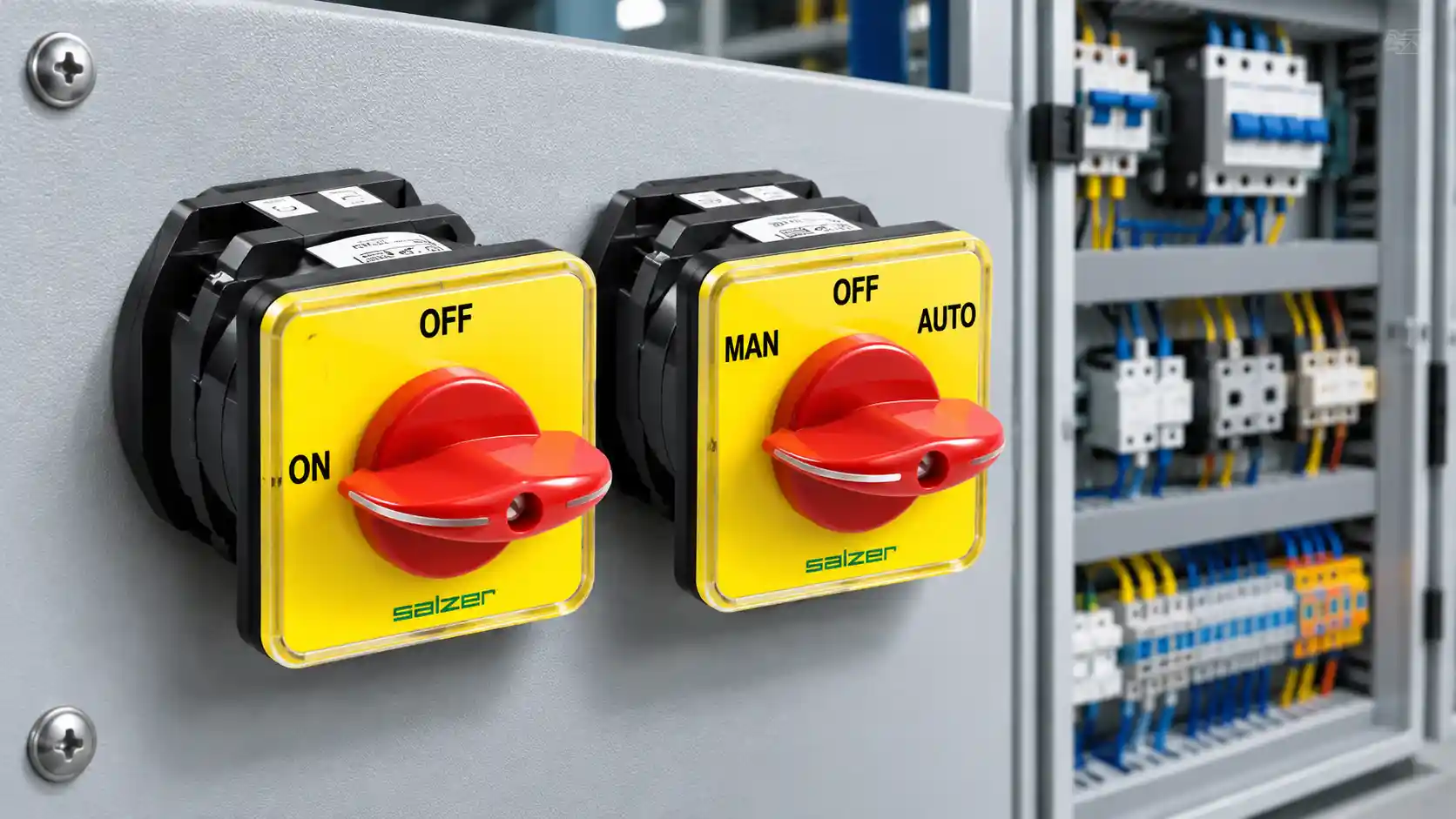
To ensure a reliable operation of an industrial electrical panel, it is crucial to choose the appropriate component of control. A selector switch might seem an easy item, yet selecting an incorrect current rating, contact arrangement or switching order can result in control circuit complications, incompatibility and unwarranted panel alteration.
A Salzer Selector Switch is a typical component in industrial control panels to switch control circuits, provide manual command inputs and select operating modes. Nonetheless, it is not sufficient to choose a switch according to its appearance or number of positions. Its electrical ratings, contact arrangement and operating mechanism should be suitable to the intended use.
In this guide, we describe how Salzer Selector Switch Contact Ratings, 2-position and 3-position options, switching sequences and mounting needs affect selection to enable the engineer, panel builders and purchasing teams to make better decisions.
What Is a Salzer Selector Switch?
A Salzer Selector Switch is a manually operated electrical switching device that is used to switch between various conditions of a circuit, operating modes or control functions. It has a rotary mechanism that enables an operator to alternate between predetermined positions, which is why it can be adapted to industrial machinery and electrical control panels.
A rotary selector switch is often used for functions such as
- Choosing auto or manual driving.
- Turning on and off equipment.
- Selecting forward or reverse control commands.
- Switching to alternative operating modes.
- Alternation between functions of control circuits.
The purpose of the use of a selector switch is control and switching rather than protection, as is the case with protective devices like circuit breakers. They do not usurp overload protection, short-circuit protection or other safety devices needed by the circuit.
Understanding Contact Ratings in Salzer Selector Switches
The rating of the Salzer Selector Switch Contact identifies the maximum safe and reliable operation of the switch contacts in the electrical conditions of the intended circuit.
The current rating of a switch does not necessarily mean that it will suit all applications. Real performance is based on operating voltage, type of load, switching frequency, electrical characteristics and the type of utilization category.
Current and Voltage Ratings
In gauging a selector switch current rating, there is an operational current and operational voltage to be taken into account.
- Current rating: The amount of current that the contacts can carry when under specified conditions.
- Voltage rating: The operating voltage within which the switch is supposed to operate within the limits stated by the manufacturer.
- Load characteristics: Various loads can involve the contacts, including resistive, inductive or motor-related loads.
- Switching frequency: Inductive loads can be subject to frequent switching, which can have an impact on the contact life.
Always check the electrical specifications of the manufacturer before using a switch in a certain circuit.
AC-15 vs AC-21 vs AC-23 Ratings
The types of electrical utilization aid in identifying the kind of load that a switch can be used for. These are significant when comparing AC-15 Rating, AC-21 Rating and AC-23 Rating.
| Utilization Category | Typical Application | Selection Consideration |
|---|---|---|
| AC-15 | Control loads that are electromagnetic, like contactor coils. | Take into account switching duty, voltage and coil current. |
| AC-21 | Controlling resistive loads and moderately inductive loads, such as controlled overload conditions. | Check load characteristics and rating. |
| AC-23 | Switching motor loads or loads with a high inductance. | Check motor duty, initial conditions and category-specific ratings. |
These are not categories that can be used interchangeably. A switch that is rated in one type of application might not be suitable in another application, even where the nominal current seems sufficient.
To ensure dependable operation, adjust the utilization category and electrical ratings to the real-world circuit requirements and datasheet.
2-Position vs 3-Position Salzer Selector Switches
The number of operating positions defines the possible operator selections, although the role of each position varies depending on the contact arrangement and switching sequence.
When there are two operating states that are needed, a 2-position selector switch is generally utilized. Another state may be a neutral or alternate operating mode and may be offered by a 3-position selector switch.
| Feature | 2-Position Selector Switch | 3-Position Selector Switch |
|---|---|---|
| Number of positions | Two | Three |
| Typical functions | ON–OFF, Enable–Disable | MAN–OFF–AUTO, FWD–OFF–REV |
| Operating flexibility | Two-state controllable. | Appropriate to three-state control. |
| Circuit requirements | A single or multiple contacts based on design. | There can be different combinations of contacts depending on position. |
| Common applications | Simple control and mode selection. | Multi-mode control panels and equipment. |
The above examples are indicative of the way it can be applied. Ensure that the particular model of the selector switch has the necessary function and switching sequence.
When Should You Choose a 2-Position Selector Switch?
The 2-position switch can be used when the operator requires the ability to select between two specified circuit states.
Common examples include:
- ON and OFF
- Local and Remote
- Enable and Disable
- Open and closed commands.
It can be considered as a simple choice in terms of having simple control requirements where no extra operating mode is required.
When Should You Choose a 3-Position Selector Switch?
A 3-position switch comes in handy when a machine or system needs three different options.
As an example, a MAN-OFF-AUTO setup can be used to permit manual operation, a neutral or disabled condition, and automatic operation. When implemented within a suitable control circuit, an FWD-OFF-REV arrangement can supply directional commands.
The necessary contacts, interlocking, and switching sequence should be verified during the selection.
How Contact Configuration Affects Switching Logic
The selector switch contact configuration defines which contacts switch state as the operator switches between positions of the switch.
Two switches having the same number of positions can be used to operate entirely different circuits. One can be a single contact and the other can have multiple contacts, which operate in a given order.
It is on this account that when in doubt one should consult the contact diagram and not just the front marking of the switch or the number of positions.
NO, NC and contact sequencing
When choosing a switch to use in industrial control, it is important to understand NO NC contacts.
- Normally Open (NO): The contact is open in its normal reference state and is closed when it is operated as specified.
- Normally Closed (NC): In its natural reference state, the contact is closed and closes when used as indicated.
Reference states and contact transitions in selector switches should be read in the switching diagram of the manufacturer. The diagram shows the active or inactive contacts in each position of the selectors.
Before ordering, check:
- NO and NC number of contacts.
- Contact state at each position.
- What are the contacts that vary jointly?
- Where feasible, whether the transition is break-before-make or make-before-break.
- The presence of the necessary sequence in support of the desired control logic.
Maintained and Spring-Return Selector Switches
Selector switches come in various operating mechanisms, such as maintained and spring-return.
| Switch Type | How It Works | Typical Application |
|---|---|---|
| Maintained Selector Switch | Remains in the selected position until manually rotated again. | Manual/Auto mode, local/remote control. |
| Spring Return Selector Switch | Bounces back to the desired resting point once the operator releases it. | Temporary or reset control inputs, momentary commands. |
A maintained selector switch would be used in cases where the operating mode should be maintained selected in normal machine operation.
The Spring Return Selector Switch is applicable when there is a momentary command needed in the circuit instead of a constantly held selection.
The model chosen should have the return direction, resting position, and contact operation established.
How to Choose a Salzer Selector Switch to Industrial Panels.
The right switch cannot be chosen based on the number of positions. An effective Salzer Selector Switch Selection Guide ought to address the electrical, mechanical and application needs.
Match Electrical Ratings with Circuit Requirements
Before choosing a model, check the following:
- Rated operational voltage
- Rated operational current
- Utilization category
- Resistance or inductive load properties.
- Control circuit requirements
- Required contact arrangement
- Switching frequency and anticipated operating life.
Adjusting the Salzer Selector Switch Specifications to the circuit aids in minimizing the risk of inappropriate contact operation, early wear or improper choice of components.
Verify Positions, Mounting and Operating Conditions
Mechanical compatibility is also vital in a panel-mount selector switch.
Prior to procurement, check the following requirements:
- Number of operating jobs.
- Switching angle and operating sequence.
- Maintained or spring-return mechanism.
- Actuator style and handle needs.
- Cutout and mounting dimensions on a panel.
- Accessibility of wiring and terminals.
- Enclosure and environmental requirements.
- Manufacturer's installation and operating instructions
The checks assist in verifying that the chosen switch will fit the panel layout and will work as intended once installed.
Common Mistakes When Selecting Selector Switches
Even the most seasoned panel assemblers may have issues in selection when vital specifications are ignored.
Some of the most frequent selector switch selection errors are:
- Choosing based on the current rating: The choice, not taking into account utilization category or load characteristics, can lead to an inappropriate switch.
- Selecting based on number alone: Two switches with the same number of positions can have different contact logic.
- Without considering switching diagrams: The behavior of NO and NC contacts can be erroneously assumed to cause control circuit errors.
- Ignoring operating mechanisms: The operating mechanism that functions on a maintained command may not be appropriate where momentary command is needed.
- Failure to consider panel affinity: Improper mounting size or connection terminal configuration may cause installation time-outs.
- All the models are assumed to be supported: There are different combinations of contacts and sequences of switching between product models.
Spending a few minutes and reviewing the specifications prior to ordering may save wrong procurement and rework.
Where to Buy Salzer Selector Switches in India?
When you are seeking Salzer Selector Switch Suppliers in India, it is worthwhile to find a supplier who would assist you to find the right model to fit the industrial projects, control panels and electrical maintenance needs.
SS Electronics provides electrical and industrial control to its customers who are seeking a trusted procurement service. When ordering a Salzer Selector Switch, it can be more effective to specify what is required to identify the product and have the quotation.
To have a quicker query, share:
- Required model number of switching model, when necessary.
- Number of positions
- Required contact configuration
- Rated voltage and current.
- Application or control function.
- Quantity required
- Project/delivery requirements.
No matter the quantity you want to purchase in bulk or just get a single replacement switch, this information will allow you to simplify the buying process.
Conclusion: Not Just Switch Position, Select by Circuit.
To select the appropriate Salzer Selector Switch, it is imperative to have a clear concept of the contact ratings, types of use, position of operation and switching patterns. A 2-position or 3-position switch might resemble each other in design, but its real circuit operation will depend on the contact configuration and electrical requirements.
Through checking the voltage, current, load type, NO/NC position, switch order and installation, engineers and purchasers can make more assured decisions and minimize unnecessary selection mistakes.
When you are in need of sourcing the selection switches of industrial panels, machinery or electrical projects, SS Electronics will be able to assist you with your product inquiry and purchasing needs.
Looking for a Salzer Selector Switch for your application?
You can visit SS Electronics or call our team with the specifications that you need to inquire about availability, appropriate models and prices.
Select the appropriate switch to be used in your circuit. Get your industrial control needs proper at the beginning.
FAQs
1. What is a Salzer Selector Switch used for?
Depending on its configuration, a Salzer Selector Switch is installed in electrical control panels and machinery to switch between operating modes, to control the state of control circuits and to provide manual switching commands.
2. What is the difference between a 2-position and 3-position selector switch?
A 2-position selector switch offers two operating choices, e.g., ON and OFF. A 3-position selector switch indicates three selections, like MAN, OFF, and AUTO, which are supported by the model and design of the circuit.
3. How do I check the contact rating of a selector switch?
Note the datasheet of the manufacturer of the device: the rated operational voltage, current, the type of utilization and the type of load. Do not use the nominal current rating.
4. What does AC-15 mean on a selector switch?
AC-15 rating is a type of utilization category in the switching of electromagnetic control loads in AC circuits (contactor coils). The switch should be chosen with the help of the category-specific ratings.
5. What is the difference between maintained and spring-return selector switches?
A maintained switch is a type of selector switch that remains selected. A spring-return type of switch recovers to its designated rest state when released and hence can be used in momentary control applications.
6. Where can I buy Salzer selector switches in India?
SS Electronics can be contacted with a product inquiry and help in locating the right selector switch. Provide your necessary ratings, positions, contact configuration and quantity to assist in model selection and quotation.